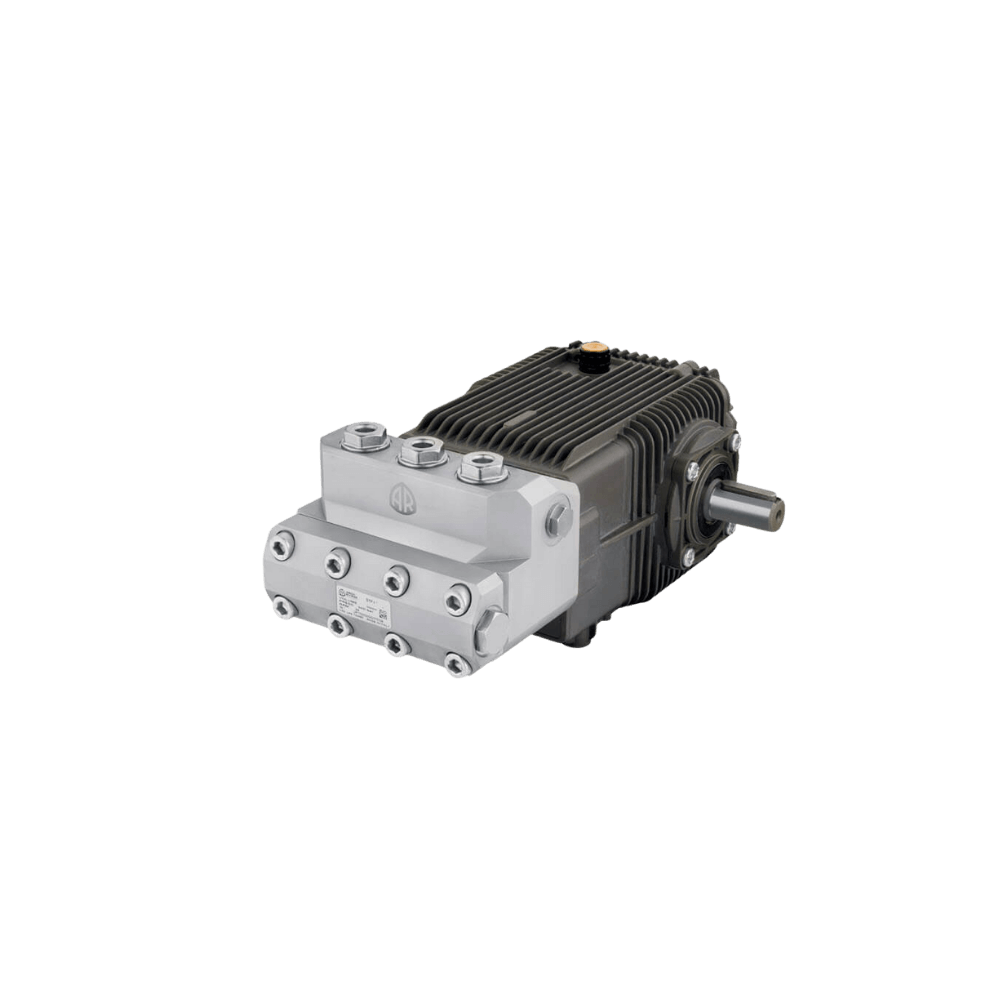
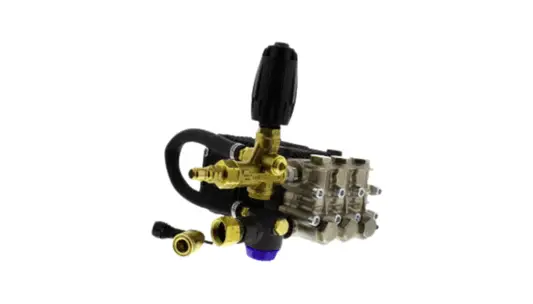
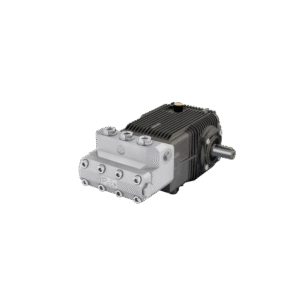
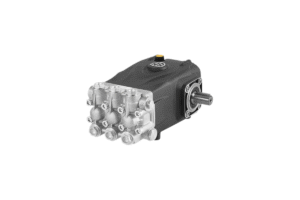
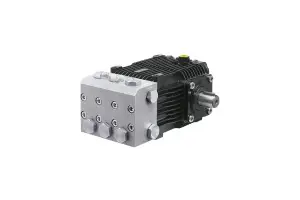
RTD, RTX and SHP are the three AR industrial series, and people mix them up constantly. The short version: they are not three grades of the same pump. They sit at three different points on the flow-versus-pressure curve, and picking between them is mostly a matter of which end of that curve your job lives on.
Here is what we actually stock, so you can see the shape of it.
The AR industrial series at a glance
Series
Flow range
Pressure range
Speed
Shaft
RTD
21 to 52.8 GPM
1,200 to 4,350 PSI
800 to 1000 RPM
35 mm
RTX
7.9 to 39.6 GPM
1,450 to 4,350 PSI
1450 to 1800 RPM
30 mm
SHP
4 to 5.8 GPM
7,250 PSI
1450 RPM
24 mm
Read the flow column and the pressure column together and the whole thing resolves. RTD moves water. SHP makes pressure. RTX covers the middle and is the one that fits in a smaller space.
RTD: when you need volume
The RTD series starts at 21 GPM and tops out at 52.8. Nothing else in AR’s catalog moves that much water. It runs slow, 800 to 1000 RPM, on a 35 mm shaft, which tells you it is a belt-driven or gear-reduced pump and always will be.
Slow speed is the reason it lasts. Plunger seal life is largely a function of how many strokes the pump makes, and a 1000 RPM pump makes a third as many as a 3400 RPM one for the same hours on the clock.
Note the trade. As flow climbs, pressure falls. That is not a limitation of the design, it is the power budget. Every one of those pumps is drawing somewhere in the 50 to 63 BHP range at full output.
One correction worth making. You will read that RTD pumps are suited to “mud and debris-laden environments.” They are not, and no triplex plunger pump is. These pumps need clean, filtered water. Grit destroys plungers and holds check valves open. The confusion comes from hydro-excavation, where an RTD is a common choice, but on a hydrovac the pump handles clean water going out and the vacuum system handles the slurry coming back. Two separate paths. Feed a plunger pump dirty water and you will be buying seals every week.
SHP: when you need pressure
The SHP series runs 7,250 PSI, which is 500 bar. Flow is 4 to 5.8 GPM. That combination is the definition of the pressure end of the curve.
The design change that gets talked about is the head, with the intake valves sitting directly above the plungers. That geometry lets the chamber fill more completely at high speed, which is what makes the pressure achievable without cavitation.
SHP is for surface preparation, coating removal, hydro-demolition and scale that will not come off any other way. It is a bad choice for general washdown. At 4 GPM you will be there all day, and 7,250 PSI will wreck most of what you point it at.
The SHPA series is the related line. The SHPA4G70HN runs 4 GPM at 7,000 PSI on an 18 mm shaft.
RTX: the middle, in a smaller box
The RTX series spans the widest range of the three, 7.9 to 39.6 GPM at 1,450 to 4,350 PSI, on a 30 mm shaft at 1450 to 1800 RPM. Smaller shaft, faster speed, smaller footprint than an RTD at comparable output.
RTX is also the line with the most variants, which matters when your build has a constraint:
RTX85-SX and RTX100-SX are left-hand shaft, for when the drive has to come in from the other side.
RTX-HW85.150N is rated to 185°F for hot water systems.
RTX-SS100.100N has a stainless head for chloride and caustic exposure.
The DD versions come as hydraulic direct-drive assemblies.
How to actually choose
Work in this order.
Pressure first. Above 4,350 PSI there is one answer and it is SHP. Below that, pressure rarely decides it.
Then flow. Above about 40 GPM, only RTD gets there. Under 20 GPM, RTX is usually the smaller and cheaper install.
Then check your power. GPM × PSI ÷ 1460 gives brake horsepower at the shaft. Size the motor 10 to 20 percent above it. An RTD200-100 wants roughly 52 BHP; an RTX30 wants about 24. That number often decides the whole thing before the pump does.
Then the mechanical fit. Shaft size, rotation direction, mounting, and whether you have room for a slow-speed pump and its drive.
One last thing about speed. RTD at 800 to 1000 RPM and RTX at 1450 to 1800 both require a reduction from a standard motor or engine. None of these are direct-drive pumps for a 3400 RPM gas engine. If someone is trying to sell you one for that, the pump will not last a season.
The Honda GX200 is a small engine, and the mistake people make with Honda GX200 pump packages is buying a
Manage Consent
To provide the best experiences, we use technologies like cookies to store and/or access device information. Consenting to these technologies will allow us to process data such as browsing behavior or unique IDs on this site. Not consenting or withdrawing consent, may adversely affect certain features and functions.
Functional
Always active
The technical storage or access is strictly necessary for the legitimate purpose of enabling the use of a specific service explicitly requested by the subscriber or user, or for the sole purpose of carrying out the transmission of a communication over an electronic communications network.
Preferences
The technical storage or access is necessary for the legitimate purpose of storing preferences that are not requested by the subscriber or user.
Statistics
The technical storage or access that is used exclusively for statistical purposes.The technical storage or access that is used exclusively for anonymous statistical purposes. Without a subpoena, voluntary compliance on the part of your Internet Service Provider, or additional records from a third party, information stored or retrieved for this purpose alone cannot usually be used to identify you.
Marketing
The technical storage or access is required to create user profiles to send advertising, or to track the user on a website or across several websites for similar marketing purposes.