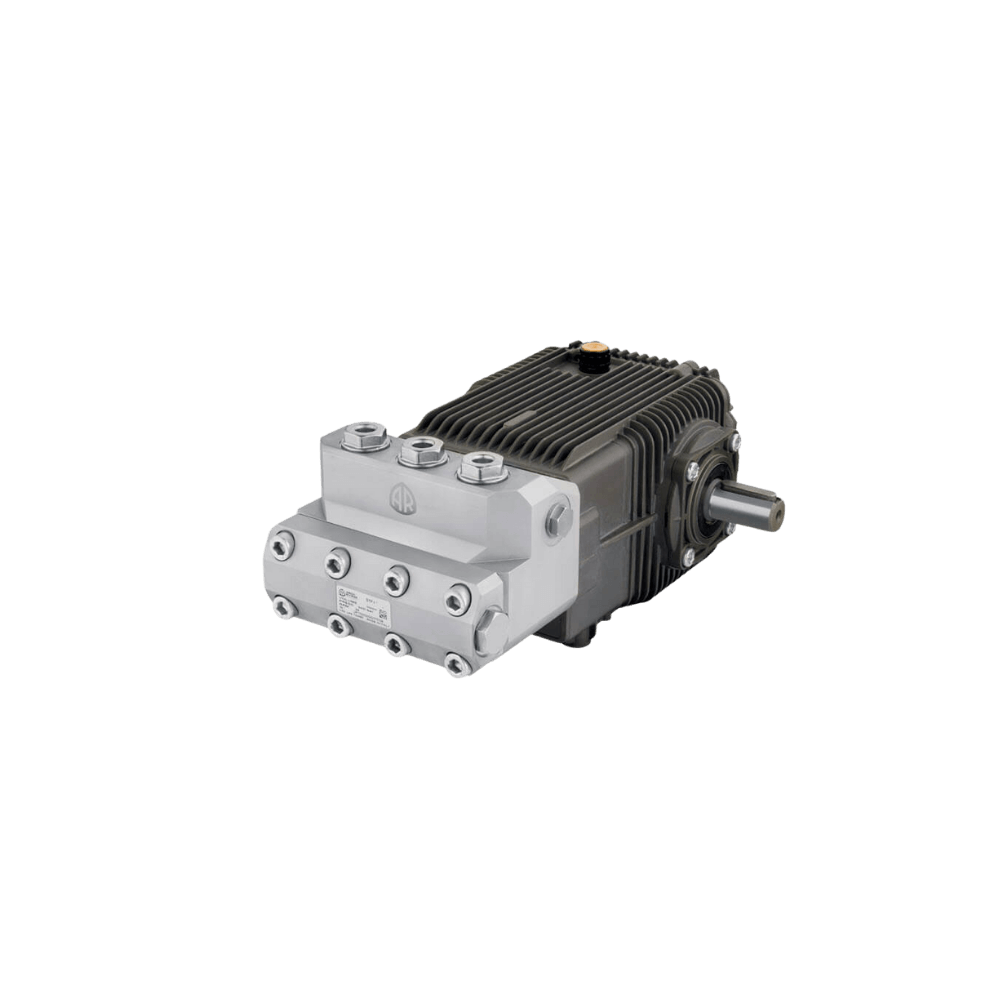
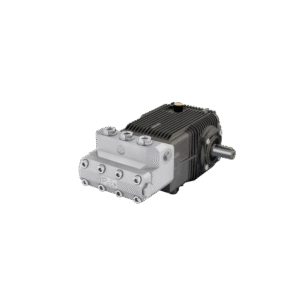
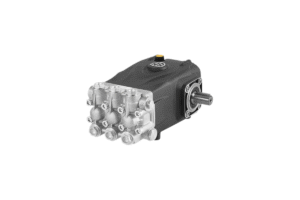
If you need to move a lot of water, the RTD series is where AR’s catalog goes. It starts at 21 GPM and runs to 52.8, which is roughly ten times what a contractor-grade machine puts out. Nothing else in their industrial line comes close on volume.
Every RTD runs at 800 to 1000 RPM on a 35 mm shaft. That is not a weakness, it is the design decision the whole series is built around, and it explains most of what people like about these pumps.
Plunger seal wear tracks strokes, not hours. A pump at 1000 RPM makes less than a third as many strokes per hour as one at 3400. Slow it down and the same seal kit lasts several times longer on the calendar. That is where the RTD’s service-life reputation comes from. It is not exotic materials, it is arithmetic.
The trade is that you need a reduction drive. There is no RTD you can bolt to a gas engine. Belt drive or a gearbox, always, and that drive is part of your budget and your footprint.
Flow costs pressure
Read down the table and you can watch the trade happen. 21 GPM gets you 4,350 PSI. 52.8 GPM gets you 1,200. That is not the pump being weaker at high flow, it is the power budget.
Run the numbers with GPM × PSI ÷ 1460:
RTD80-300: 21 × 4,350 ÷ 1460 = about 63 BHP
RTD130-160: 34.5 × 2,300 ÷ 1460 = about 54 BHP
RTD200-100: 52.8 × 1,450 ÷ 1460 = about 52 BHP
All in the same band. Size the motor 10 to 20 percent above and round to a standard frame. An RTD is a 60 to 75 HP installation in practice, which means three-phase power or a serious engine, and that is usually the real constraint rather than the pump itself.
How RTD pumps are built
Anodized aluminum crankcase. Corrosion resistance without the weight of cast iron.
Magnetic oil drain plug. Collects the metal particles that break-in and normal wear put into the oil, so you can see what is coming off the bearings. When the plug starts coming out furry, you have information.
Side oil sight glass. Check level and color without opening anything. Milky oil means water past the seals, which is a seal kit, not an oil change.
Bronze connecting rods on oversized tapered roller bearings. Tapered rollers handle the thrust load from belt tension as well as the radial load.
Solid ceramic plungers. One piece, not coated. Resistant to abrasive scoring, which is what makes seals last.
Double gasket sealing. Two seals in series with a drain between, so a primary failure leaks to atmosphere instead of into the crankcase.
Oversized inlet and outlet check valves. Necessary at these flow rates. Undersized valves throttle the pump and cause pressure drop at exactly the moment you need flow.
Brass pump head, nickel-plated on some models.
What it is not for
A note, because this gets stated wrong often. An RTD is a triplex plunger pump and it needs clean, filtered water. It does not pump mud, slurry, debris or anything abrasive. Grit scores plungers and holds check valves off their seats.
The confusion usually comes from hydro-excavation, which is a common RTD application. On a hydrovac the pump delivers clean water down the wand and the vacuum system takes the spoil back. Two separate paths that never meet. If dirty water gets to the pump inlet, you will be replacing seals constantly.
Where RTD pumps fit
Hydro-excavation, tank and vessel cleaning, large-area plant washdown, municipal work, and OEM builds where flow is the driving requirement. Available in left-hand shaft and hot-water-rated versions when the installation needs it.
If you need more pressure than flow, the SHP series goes to 7,250 PSI at low volume. If you want something smaller and faster, the RTX series covers 7.9 to 39.6 GPM. There is a comparison of all three series if you are choosing between them.
Tell us your flow, pressure and available power and we will size it. Email sales@wshpwr.com or call 505-305-7800.
The Honda GX200 is a small engine, and the mistake people make with Honda GX200 pump packages is buying a
Manage Consent
To provide the best experiences, we use technologies like cookies to store and/or access device information. Consenting to these technologies will allow us to process data such as browsing behavior or unique IDs on this site. Not consenting or withdrawing consent, may adversely affect certain features and functions.
Functional
Always active
The technical storage or access is strictly necessary for the legitimate purpose of enabling the use of a specific service explicitly requested by the subscriber or user, or for the sole purpose of carrying out the transmission of a communication over an electronic communications network.
Preferences
The technical storage or access is necessary for the legitimate purpose of storing preferences that are not requested by the subscriber or user.
Statistics
The technical storage or access that is used exclusively for statistical purposes.The technical storage or access that is used exclusively for anonymous statistical purposes. Without a subpoena, voluntary compliance on the part of your Internet Service Provider, or additional records from a third party, information stored or retrieved for this purpose alone cannot usually be used to identify you.
Marketing
The technical storage or access is required to create user profiles to send advertising, or to track the user on a website or across several websites for similar marketing purposes.