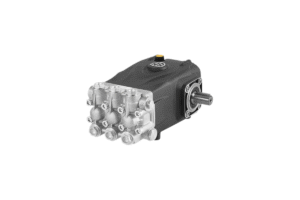
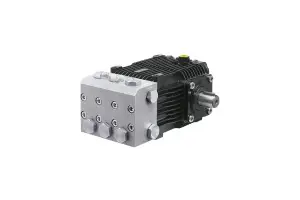
Misting is a different problem from washing, which is why RCAM Series mist pumps exist. You are not trying to remove anything, you are trying to break water into droplets small enough to evaporate before they land. That takes consistent pressure and very little flow, the opposite of what a pressure washer pump is built for.
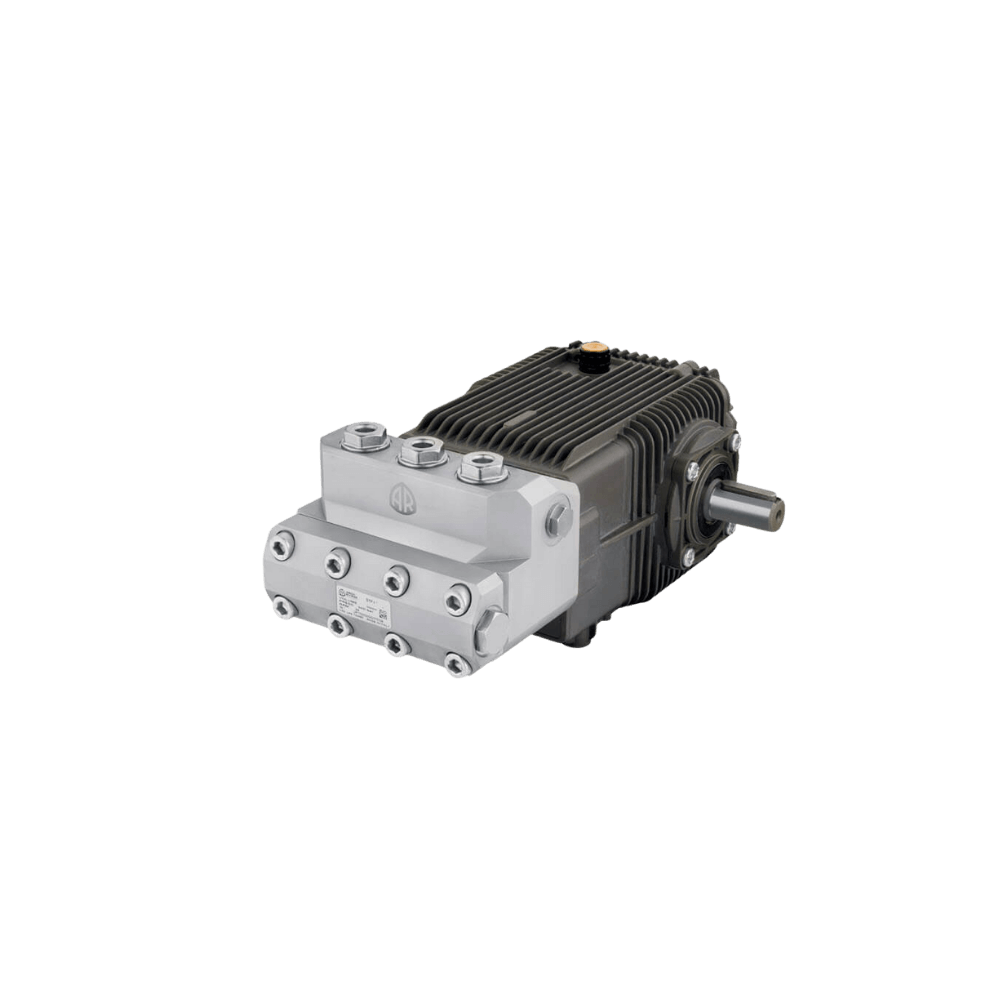
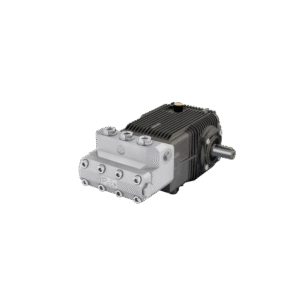
The RCAM series is AR’s answer: nine configurations from 0.25 to 2.0 GPM, all at 1,500 PSI, on an F8 flange.
Misting systems are specified from the nozzles backwards. Count your nozzles, multiply by their rated flow, add margin, and that is the pump you need.
A typical 0.012 in misting nozzle at 1,000 PSI passes roughly 0.5 GPH. A hundred of them is about 0.8 GPM, which puts you on the 1.0 GPM model. That is the calculation, and it is why the range starts at a quarter of a gallon per minute: patio and greenhouse systems genuinely need that little.
Oversizing is not harmless. A pump much larger than the nozzle set spends its life in bypass, which heats the water and shortens seal life.
Why 1,500 PSI
Droplet size falls as pressure rises. Below about 800 PSI you get spray that wets surfaces; around 1,000 PSI and above you get a fog that evaporates in air, which is what actually cools without soaking anyone.
1,500 PSI gives headroom above that threshold so the system still fogs properly at the far end of a long line, where pressure has dropped.
RCAM mist pump applications
Fogging and outdoor cooling: restaurant patios, greenhouses, event spaces
Reverse osmosis systems: as the pressure stage in water purification
Humidification: textile, printing and agricultural environments where air moisture is a process variable
Dust suppression: construction, recycling and waste facilities
Livestock cooling and greenhouse irrigation
Industrial misting tunnels and specialty spraying
RCAM mist pump design notes
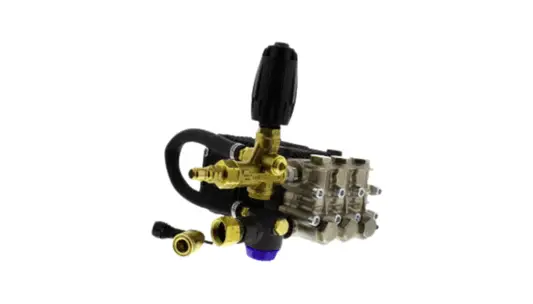
Brass head, compact and light, on an F8 flange so it bolts to a small motor face rather than needing a base and coupling. That makes it straightforward to integrate into an OEM assembly, which is what most of these end up in.
Two things matter more than the pump specification:
Water quality. Misting nozzles have tiny orifices and they block. Filter the inlet finely, and on hard water expect to descale the line periodically.
Continuous duty. These run for hours without stopping, so the crankcase oil and the seals are on a schedule even though the pump is barely working by pressure-washing standards.
The Honda GX200 is a small engine, and the mistake people make with Honda GX200 pump packages is buying a
Manage Consent
To provide the best experiences, we use technologies like cookies to store and/or access device information. Consenting to these technologies will allow us to process data such as browsing behavior or unique IDs on this site. Not consenting or withdrawing consent, may adversely affect certain features and functions.
Functional
Always active
The technical storage or access is strictly necessary for the legitimate purpose of enabling the use of a specific service explicitly requested by the subscriber or user, or for the sole purpose of carrying out the transmission of a communication over an electronic communications network.
Preferences
The technical storage or access is necessary for the legitimate purpose of storing preferences that are not requested by the subscriber or user.
Statistics
The technical storage or access that is used exclusively for statistical purposes.The technical storage or access that is used exclusively for anonymous statistical purposes. Without a subpoena, voluntary compliance on the part of your Internet Service Provider, or additional records from a third party, information stored or retrieved for this purpose alone cannot usually be used to identify you.
Marketing
The technical storage or access is required to create user profiles to send advertising, or to track the user on a website or across several websites for similar marketing purposes.