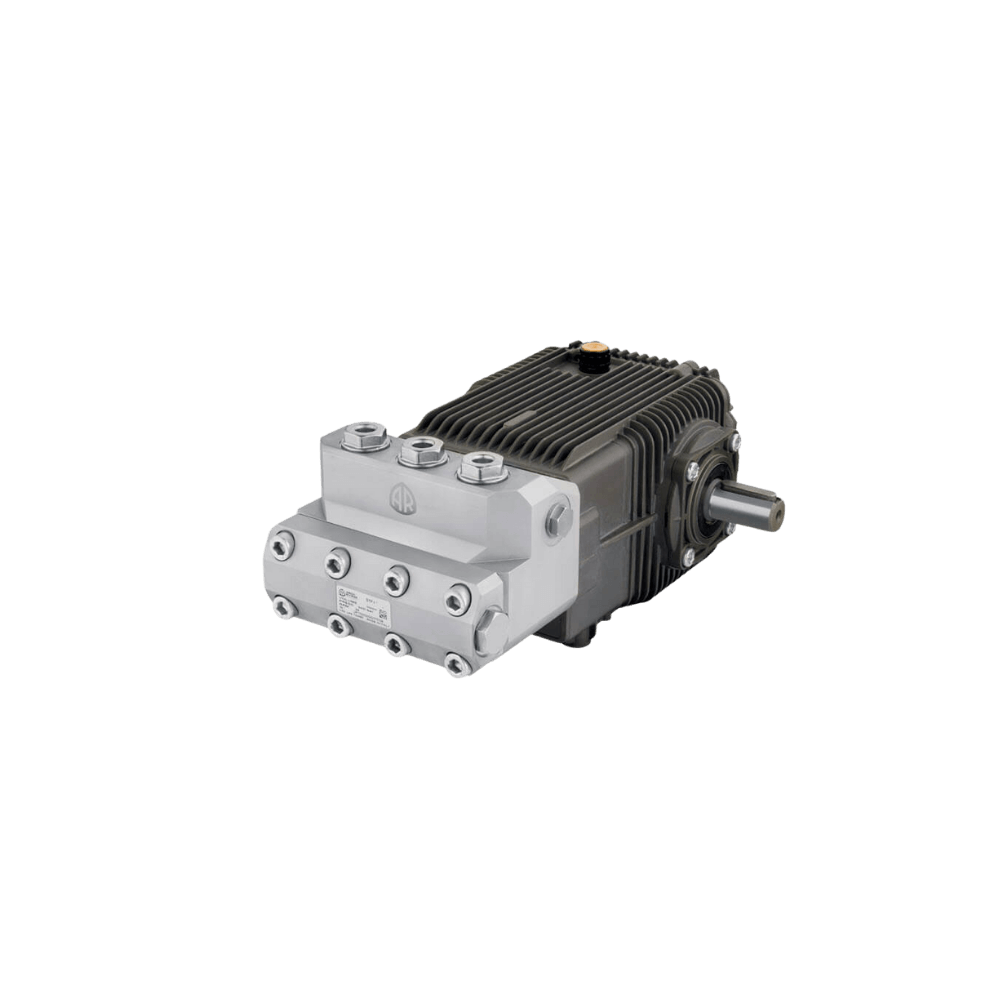
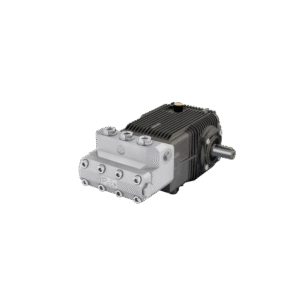
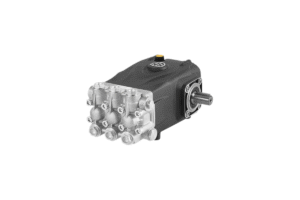
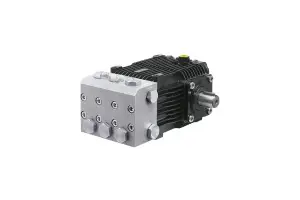
The RTD Series is the largest pump family AR makes: 21 to 52.8 GPM, on a 35 mm solid shaft, turning at 1,000 RPM with a 110 oz crankcase.
A thousand RPM is slow even by industrial standards, and it is the single most important number here. At this size and load, speed is what would destroy the pump, so the design gives it up in exchange for years of service.
The spread is from 42 to 69 HP at the shaft, so with margin you are specifying 50 to 75 HP motors or a hydraulic circuit with equivalent capacity. That is a serious electrical installation and it should be settled before anything else.
Specialist RTD pumps
RTD100-200SX, left-hand shaft for mirrored installations
RTDSS80-300N, food-grade 420 stainless head at 21 GPM / 4,350 PSI
The stainless and hot water versions are worth knowing about, because they cover the two conditions that kill a standard head at this size: sanitizer chemistry and temperature.
Two ends of the same RTD pump range
The RTD80-300 at 21 GPM and 4,350 PSI and the RTD200-100 at 52.8 GPM and 1,450 PSI need almost the same shaft power, and they do completely different work.
4,350 PSI removes coating and scale. 52.8 GPM moves water across a surface faster than anything else in the catalog. Deciding which you need is the whole selection process; the models in between are compromises between the two.
How RTD pumps are built
Brass or nickel-plated brass head, with a stainless option on the SS models
Bronze connecting rods, for the torque that comes with low-speed operation
Oversized pistons and valves, sized for the volume
110 oz oil capacity, SAE30
35 mm solid shaft
1,000 RPM, 800 on the L160
Feeding an RTD pump
A 52.8 GPM pump needs 52.8 GPM delivered, continuously, at positive inlet pressure. That is a serious supply system, not a plumbing afterthought: a tank above the pump, a short full-bore feed line sized well above the inlet port, and full-flow valves.
Cavitation at this scale is not a noise, it is a rebuild. And rebuilds on an RTD are not cheap.
Where RTD pumps are used
Hydro-demolition and concrete cutting
Mining and quarrying: heavy-duty cleaning and processing
Steel production and foundries: furnace cleaning, slag removal, descaling
Oil and gas: rig sanitation, hydrostatic testing, wellhead cleaning
Municipal: bridge and dam maintenance, graffiti, wastewater treatment
Shipyards and marine: hull cleaning, barnacle removal, dock sanitation
Power generation: boiler tube cleaning, cooling towers, turbine support
Food processing, with the stainless head version
Servicing RTD pumps
Rebuildable, with valve kits, piston kits in Ø32, Ø36 and Ø40, matching water seals and piston guides, oil seals, hot water seal sets, inlet and outlet plug kits, rail kits and grease fittings. Kits are sized by plunger diameter, so identify your model before ordering.
Oil is SAE30 non-detergent, AR645107. At 110 oz you need roughly one container per change with some left over.
At this size the maintenance schedule is the entire ownership case. Oil on interval, seals replaced before failure, inlet filtered and monitored. Done properly these run for many thousands of hours.
The Honda GX200 is a small engine, and the mistake people make with Honda GX200 pump packages is buying a
Manage Consent
To provide the best experiences, we use technologies like cookies to store and/or access device information. Consenting to these technologies will allow us to process data such as browsing behavior or unique IDs on this site. Not consenting or withdrawing consent, may adversely affect certain features and functions.
Functional
Always active
The technical storage or access is strictly necessary for the legitimate purpose of enabling the use of a specific service explicitly requested by the subscriber or user, or for the sole purpose of carrying out the transmission of a communication over an electronic communications network.
Preferences
The technical storage or access is necessary for the legitimate purpose of storing preferences that are not requested by the subscriber or user.
Statistics
The technical storage or access that is used exclusively for statistical purposes.The technical storage or access that is used exclusively for anonymous statistical purposes. Without a subpoena, voluntary compliance on the part of your Internet Service Provider, or additional records from a third party, information stored or retrieved for this purpose alone cannot usually be used to identify you.
Marketing
The technical storage or access is required to create user profiles to send advertising, or to track the user on a website or across several websites for similar marketing purposes.