Heat does something to grease that pressure cannot. If your work involves oil, fat or anything that softens when warm, a hot water pump is not a luxury upgrade, it is a different tool.
Why heat works
Grease and oil are solid or semi-solid at ambient temperature. Cold water hits them and bounces off, which is why you end up standing there at 4,000 PSI moving a grease film around instead of removing it.
Heat lowers the viscosity of the soil so it releases from the surface, and it makes detergent work faster because chemical reaction rates climb with temperature. The practical result is that hot water at moderate pressure removes grease that cold water at high pressure will not touch.
Where that matters:
Restaurant and kitchen work. Hood filters, grease pads, back-of-house floors.
Automotive and fleet shops. Engine bays, shop floors, undercarriages.
Food processing. Protein and fat films that bond hard to stainless.
Oil-stained concrete. The stain is absorbed into the pores, and heat is what mobilizes it.
Hot water also shortens cycle times generally, which is worth money on any job you bill by the hour. And on sanitation work, temperature is part of the protocol rather than a bonus.
What makes a pump hot water rated
This is the part the spec sheet does not explain, and it is the reason you cannot simply run hot water through the pump you already have.
Three things change:
Seals and packing. This is the main one. Standard Buna nitrile seals harden and lose their sealing ability at sustained high temperature. Hot water pumps use Viton or PTFE, which hold their properties at 185°F and keep sealing against the plunger.
Thermal management. Hot inlet water means less margin before the pump overheats, so hot water models are built with attention to how heat gets out of the head and away from the crankcase.
Clearances. Metal expands. A pump designed to run at 185°F accounts for that in the fits between plunger, seal and head.
Run a standard pump on genuinely hot water and the seals go first, usually within days. You will see it as water at the seal drain and then milky oil in the sight glass.
140°F is not hot water
Worth stating plainly, because it costs people pumps every year.
Most standard cold-water pumps carry a maximum inlet temperature around 140°F. That is a tolerance for warm supply water, from a black tank in the sun or a building’s hot tap. It is not a hot water rating.
A real hot water system with a burner runs 180 to 195°F. The pumps built for it are marked HT, HW or H in the model number and are typically rated to 185°F. If you have a burner on your rig, you need one of those. There is no middle ground where a 140°F pump is fine on a 185°F system.
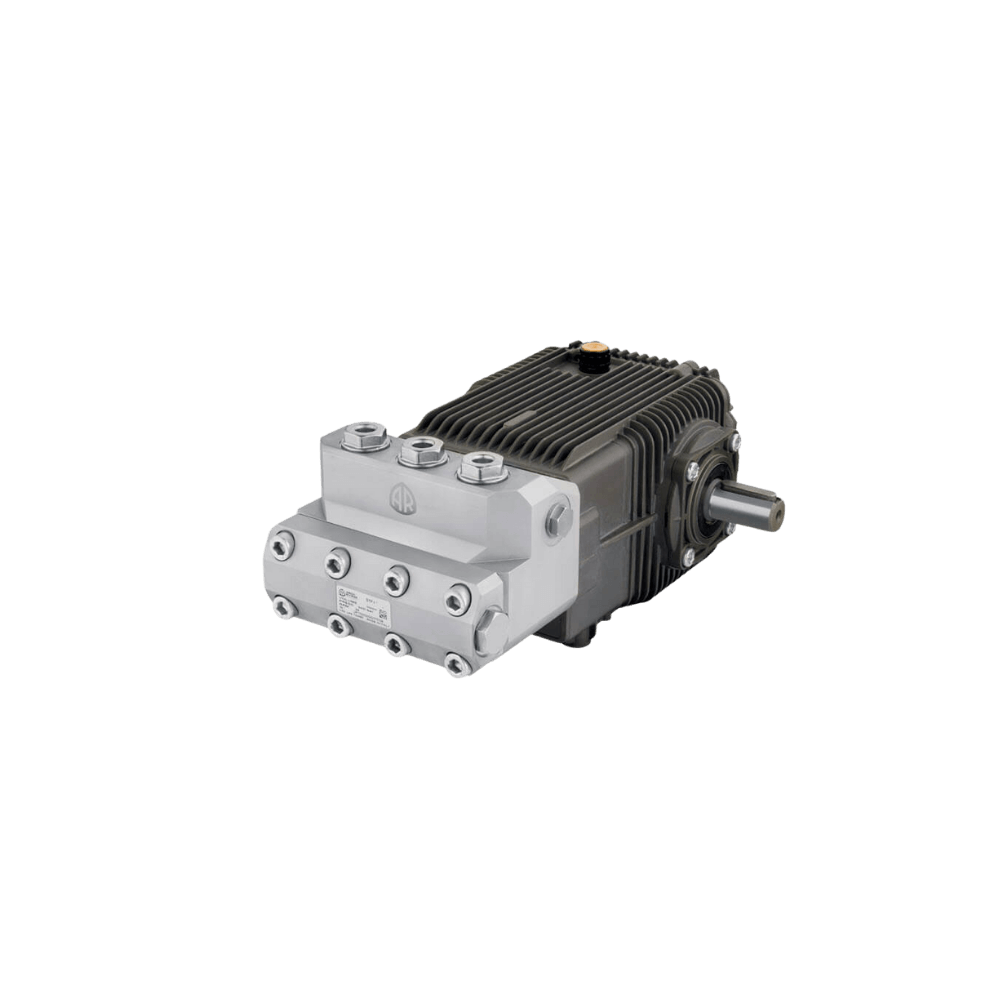
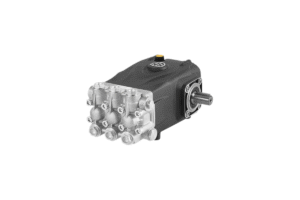
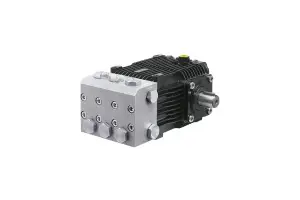
For higher pressure hot water work, the SXWA7G50NHT runs 7 GPM at 5,000 PSI, and the XWM2128HT gives 5.5 GPM at 4,060 PSI.
You may need stainless too
Hot water rating and head material are separate specifications. Heat is hard on seals; chemistry is hard on the head. If you are running caustics or chlorides hot, which is common in food plants, you want both. Look for SS in the part number alongside the HT or HW designation, and see our stainless range.
Running a hot water pump well
Do not idle in bypass. On a hot water system this is worse than on a cold one. Recirculating water that is already at 185°F climbs fast with nowhere to go.
Warm it up gradually. Start on cold water, then bring the burner in. Do not hit a cold pump with 185°F water.
Cool it down before shutdown. Kill the burner and let cold water run through for a minute before you stop the machine. This keeps hot water from sitting in the head after the flow stops.
Descale the coil. Heat drives mineral deposition. Scale in the coil restricts flow and eventually means replacing it.
Browse the full hot water pump range. If you are converting a cold water rig or replacing a pump on an existing hot water machine, tell us your flow, pressure and burner temperature and we will match it. Contact us here.
The Honda GX200 is a small engine, and the mistake people make with Honda GX200 pump packages is buying a
Manage Consent
To provide the best experiences, we use technologies like cookies to store and/or access device information. Consenting to these technologies will allow us to process data such as browsing behavior or unique IDs on this site. Not consenting or withdrawing consent, may adversely affect certain features and functions.
Functional
Always active
The technical storage or access is strictly necessary for the legitimate purpose of enabling the use of a specific service explicitly requested by the subscriber or user, or for the sole purpose of carrying out the transmission of a communication over an electronic communications network.
Preferences
The technical storage or access is necessary for the legitimate purpose of storing preferences that are not requested by the subscriber or user.
Statistics
The technical storage or access that is used exclusively for statistical purposes.The technical storage or access that is used exclusively for anonymous statistical purposes. Without a subpoena, voluntary compliance on the part of your Internet Service Provider, or additional records from a third party, information stored or retrieved for this purpose alone cannot usually be used to identify you.
Marketing
The technical storage or access is required to create user profiles to send advertising, or to track the user on a website or across several websites for similar marketing purposes.