Sewer nozzle sizing matters more than price, and price is how these usually get chosen. That is backwards: the nozzle is the business end of the whole rig. The nozzle decides whether the hose reaches the blockage, whether the blockage comes out, and whether the debris leaves the pipe or gets pushed further in.
There are three things to get right: inlet size, orifice size, and the split between forward and rear jets. Everything else is secondary.
Sewer nozzle sizing: thrust or cutting
Every jetting nozzle divides its water between jets aimed backwards, which push the hose up the line, and jets aimed forwards, which attack the blockage. That split is the specification that matters most and the one least often stated on a shelf tag.
- Grease and sediment flush downstream. Favour rear-jet thrust: drive the nozzle past the deposit and wash it out on the way back.
- Roots and hard scale have to be cut. Favour forward jets.
- Long runs need more thrust regardless, because the nozzle is dragging more hose behind it.
Crews who carry both configurations avoid the second trip. Crews who carry one configuration make the second trip.
Match the inlet to your hose, then the orifice to your pump
Inlet size is a fitting question and it is binary: it either threads onto your jetter hose or it does not. The families below cover 1/8, 1/4 and 3/8 in.
Orifice size is the one that has to match your pump. The number in the part name is the orifice. Too small and pressure climbs past what the system is rated for. Too large and pressure never builds, so the nozzle will not generate thrust and will stall in the line without ever reaching the blockage.
This is the single most common jetting mistake, and it presents as a nozzle that “does not work” when the nozzle is fine and the sizing is wrong.
The MLRSN rotating nozzles
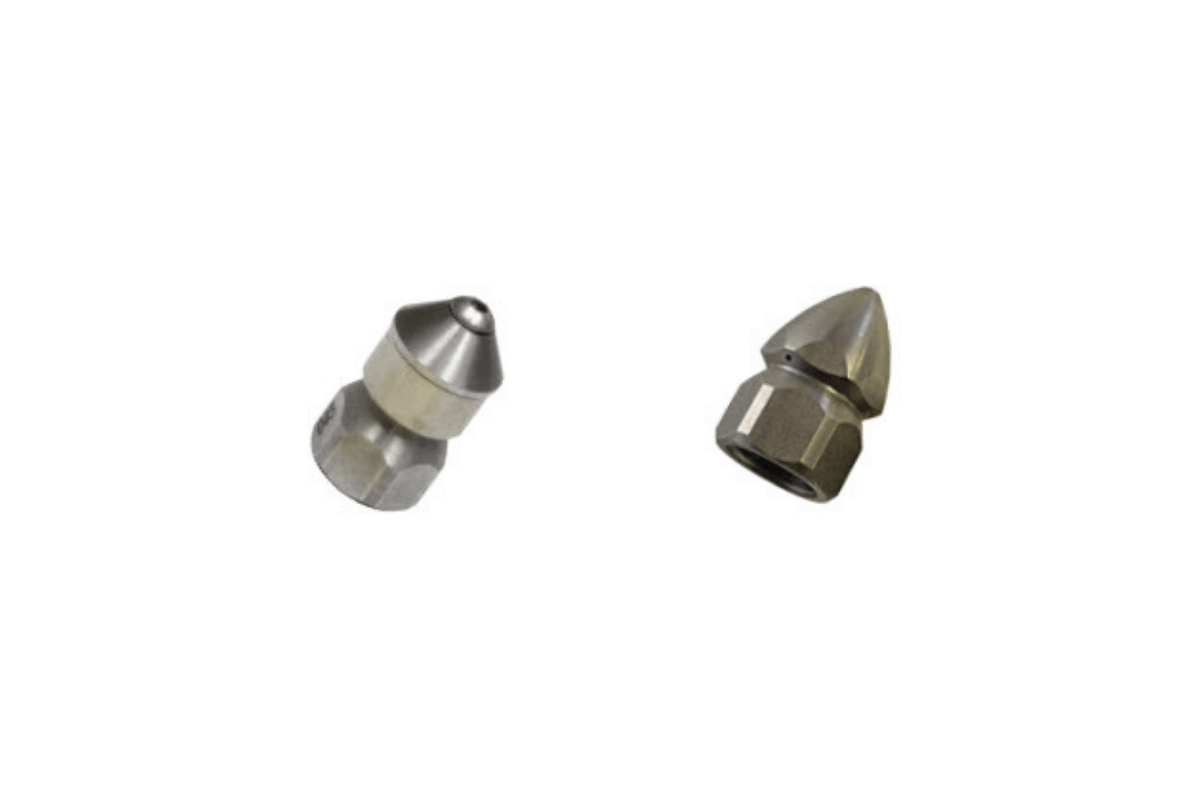
Rotating heads for smaller lines and tight access: residential drains, lateral sewer lines, grease traps and food service lines. The rotation is what lets a small nozzle scour the full pipe wall rather than cutting one channel through the deposit.
The MLSSSN three-hole nozzles
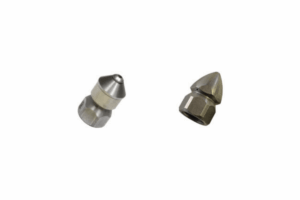
Fixed three-hole orifice heads, in stainless. These are the everyday nozzles for commercial property maintenance, smaller municipal work and rental fleets, and they are cheap enough that a crew can carry several sizes rather than compromising on the one they happen to have.
The AL nozzles, for larger lines
Bigger orifices and more thrust, for municipal storm drains, industrial pipe and high-volume contract work. This is the family to look at when the pipe is large enough that a small nozzle simply cannot move the water it needs to.
A note on pressure and temperature ratings
Worth being straight about this, because it affects how you should specify.
AR does not publish pressure or temperature ratings for the MLRSN, MLSSSN or AL nozzle families. We are not going to invent figures for them. If you need a rated nozzle on a documented system, the SNA series is the one that carries published numbers: 4,350 PSI and 320°F, with 1/4 in M inlets on the SNA1, SNA2 and SNA3, and 1/2 in F or 3/8 in F on the SNA4.
For the other three families, tell us your jetter’s flow, pressure and whether you run hot, and we will confirm what a given nozzle will take before you buy rather than after.
Where this work is
- Municipal: storm drains, culverts, sewer mains and lateral maintenance programmes
- Plumbing contractors: residential and commercial sewer calls
- Property management: apartment blocks, schools, commercial kitchens
- Industrial: chemical plants, food processing, manufacturing waste lines
- Environmental services: grease traps, septic systems, waste management
Before you jet
Jetting is more hazardous than surface cleaning for one reason: the working end is out of sight.
- A nozzle can reverse and come back out of the pipe at the operator. Never retrieve a running nozzle to the entry point.
- Use a foot control so stopping the water does not require letting go of the hose. The AL0124722810 is rated 3,000 PSI and the AL0124722830 5,000 PSI.
- Match nozzle to flow. An oversized orifice will not generate thrust and will stall in the line.
- Confined space rules apply in manholes and vaults, and they are not optional.
Equipping a truck
Carry more than one size. A crew with only 3/8 in nozzles cannot service a residential lateral, and a crew with only 1/8 in nozzles will spend a day failing to clear a storm main. Two or three orifice sizes in each thrust configuration covers nearly everything most operations encounter.
Browse the full sewer and drain range, or send your jetter’s flow and pressure and the pipe sizes you maintain and you will get a nozzle set specified for it rather than a category to browse.