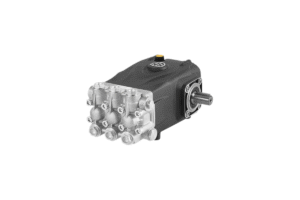
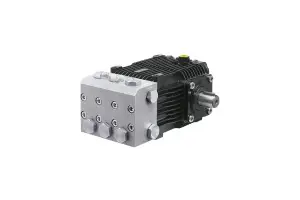
There is a naming problem in this industry that trips up a lot of buyers, so let me clear it up before anything else. A triplex pump is a piston pump. Three of them, side by side. The word triplex just means three plungers driven off one crankshaft. So when a spec sheet or a sales rep asks whether you want “triplex or piston,” the question is wrong.
The comparison that actually matters is triplex plunger versus axial cam. Those are two genuinely different machines, and the difference shows up in how long the pump lasts and what it costs you to keep running.
How the two designs differ
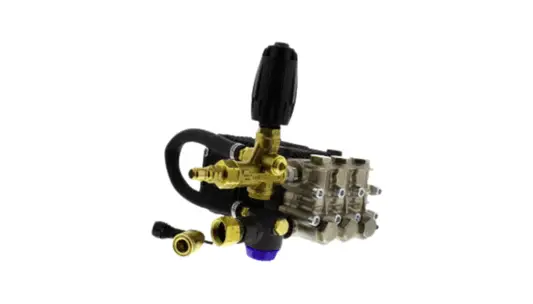
An axial cam pump (sometimes called a wobble plate or swash plate pump) has pistons arranged in a ring, parallel to the driveshaft. A tilted plate spins and pushes them in and out. It is compact, cheap to build, and it bolts straight onto an engine or motor shaft. Almost every big-box consumer pressure washer uses one.
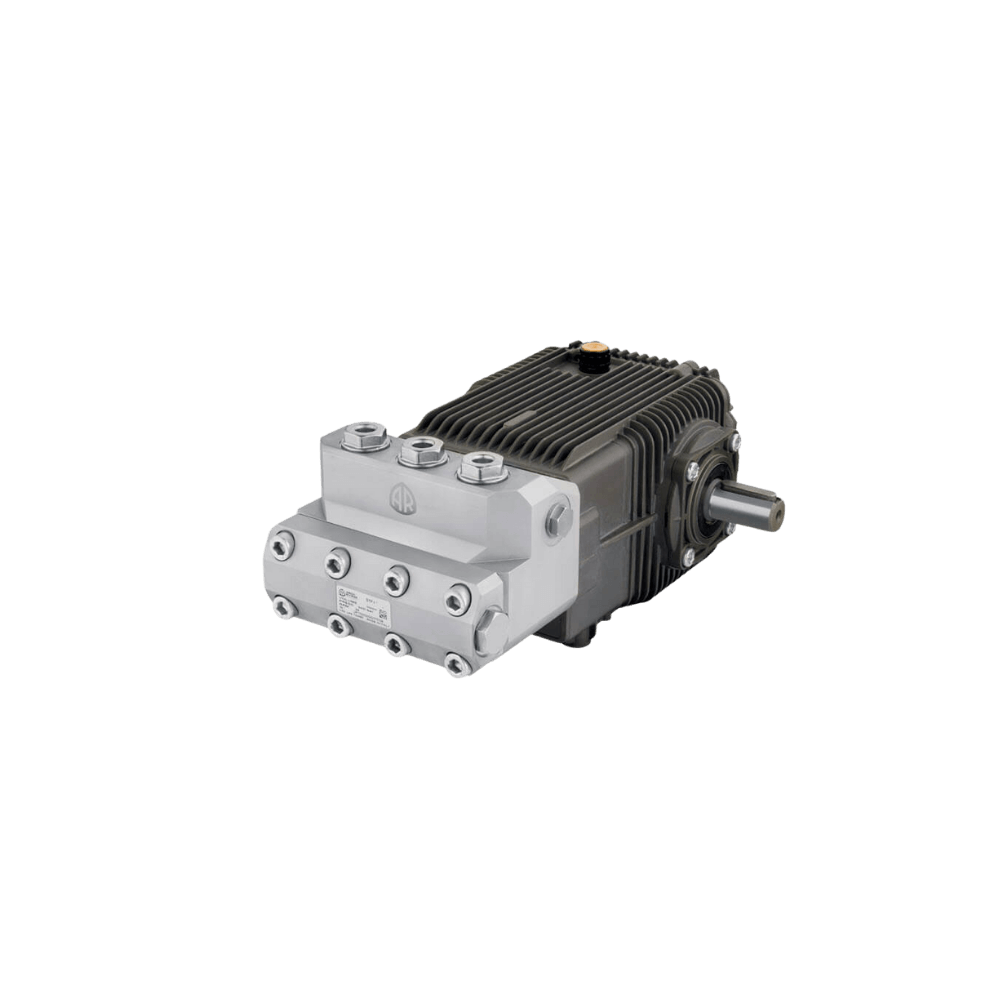
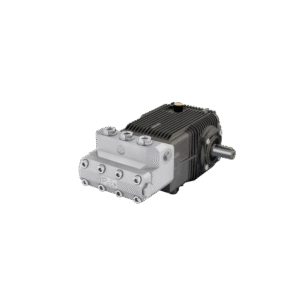
A triplex plunger pump uses a crankshaft and connecting rods, the same basic layout as a car engine. Three plungers reciprocate in a line, each one running in its own sealed bore. The crankcase holds oil and is isolated from the water side.
That isolation is the whole story. On a triplex, the oil never touches the water and the water never touches the bearings. On an axial, the pistons and the drive mechanism share a much closer relationship, and a seal failure contaminates the works.
Why a triplex plunger pump runs smooth
You will see it written that the three plungers work “in unison.” They do not, and it is important that they do not. They are offset 120 degrees on the crankshaft, so one is always on its discharge stroke while another is filling. That overlap is what flattens the pressure curve.
A single-plunger pump would put out a violent pulse and then nothing. Three plungers phased apart bring residual pulsation down to roughly 5 to 6 percent of working pressure. You feel that at the gun as a steady jet instead of a hammering one, and the hose, the fittings and the unloader all live longer for it.
What ceramic actually buys you
Ceramic plungers are the other half of the pitch, and they are worth the money, but not for the reason usually given.
Ceramic is far harder than stainless or chrome-plated steel. The failure mode on a plunger is abrasive wear from grit in the water scoring the surface, and once it is scored it chews through the seal packing. A ceramic surface resists that scoring, so the seals last several times longer. That is the benefit: fewer seal kits, not an indestructible pump.
Two things ceramic does not do:
It does not make the pump chemical-proof. The plunger is one wetted part. The head, the valves, the seals and the o-rings are the rest, and those are what limit your chemical compatibility. A ceramic plunger in a brass head still has a brass head. If you are running caustics or chlorides, you need a stainless head, and that is a separate line item on the model number.
It does not survive freezing or cavitation. Ceramic is hard, which also means brittle. A column of water left in the head over a cold night expands and cracks plungers. Starving the inlet so the pump cavitates does the same thing over a longer period. Both of those kill ceramic faster than they kill steel.
When the axial is the right call
I am not going to tell you a triplex is always correct. An axial pump is the better buy when the machine runs a few hours a month, when the budget is tight, and when nobody is going to be rebuilding anything. Axials are generally not rebuildable in any economic sense. You run it until it quits and you replace it.
The math flips fast with hours. Axial pumps are usually rated for something in the range of a few hundred hours of service life. A triplex with a proper oil change schedule runs for thousands, and every part in it is a stocked item. If the machine works every day, the triplex is cheaper by a wide margin even though the sticker is higher.
Picking a pump size
Once you have decided on a triplex, flow and pressure set the rest. A rough figure for the power the pump needs at the shaft:
GPM × PSI ÷ 1460 = brake horsepower
Size the motor or engine 10 to 20 percent above that number and round up to a standard frame. A few examples from what we stock:
Note the RPM column. Those industrial pumps are 1450 RPM machines, which means they are built to be belt driven or run off a four-pole motor, not bolted to a 3400 RPM gas engine. Running a slow pump fast is one of the more expensive mistakes you can make.
If you tell me your flow, your pressure and what is turning the pump, I can narrow it to a couple of part numbers. Get in touch and we will work it out.
The Honda GX200 is a small engine, and the mistake people make with Honda GX200 pump packages is buying a
Manage Consent
To provide the best experiences, we use technologies like cookies to store and/or access device information. Consenting to these technologies will allow us to process data such as browsing behavior or unique IDs on this site. Not consenting or withdrawing consent, may adversely affect certain features and functions.
Functional
Always active
The technical storage or access is strictly necessary for the legitimate purpose of enabling the use of a specific service explicitly requested by the subscriber or user, or for the sole purpose of carrying out the transmission of a communication over an electronic communications network.
Preferences
The technical storage or access is necessary for the legitimate purpose of storing preferences that are not requested by the subscriber or user.
Statistics
The technical storage or access that is used exclusively for statistical purposes.The technical storage or access that is used exclusively for anonymous statistical purposes. Without a subpoena, voluntary compliance on the part of your Internet Service Provider, or additional records from a third party, information stored or retrieved for this purpose alone cannot usually be used to identify you.
Marketing
The technical storage or access is required to create user profiles to send advertising, or to track the user on a website or across several websites for similar marketing purposes.