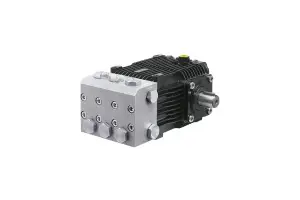
What is a triplex pump? It is one of those words that gets used constantly in this industry and explained almost never. Here is the plain version.
What is a triplex pump: three plungers on a crankshaft
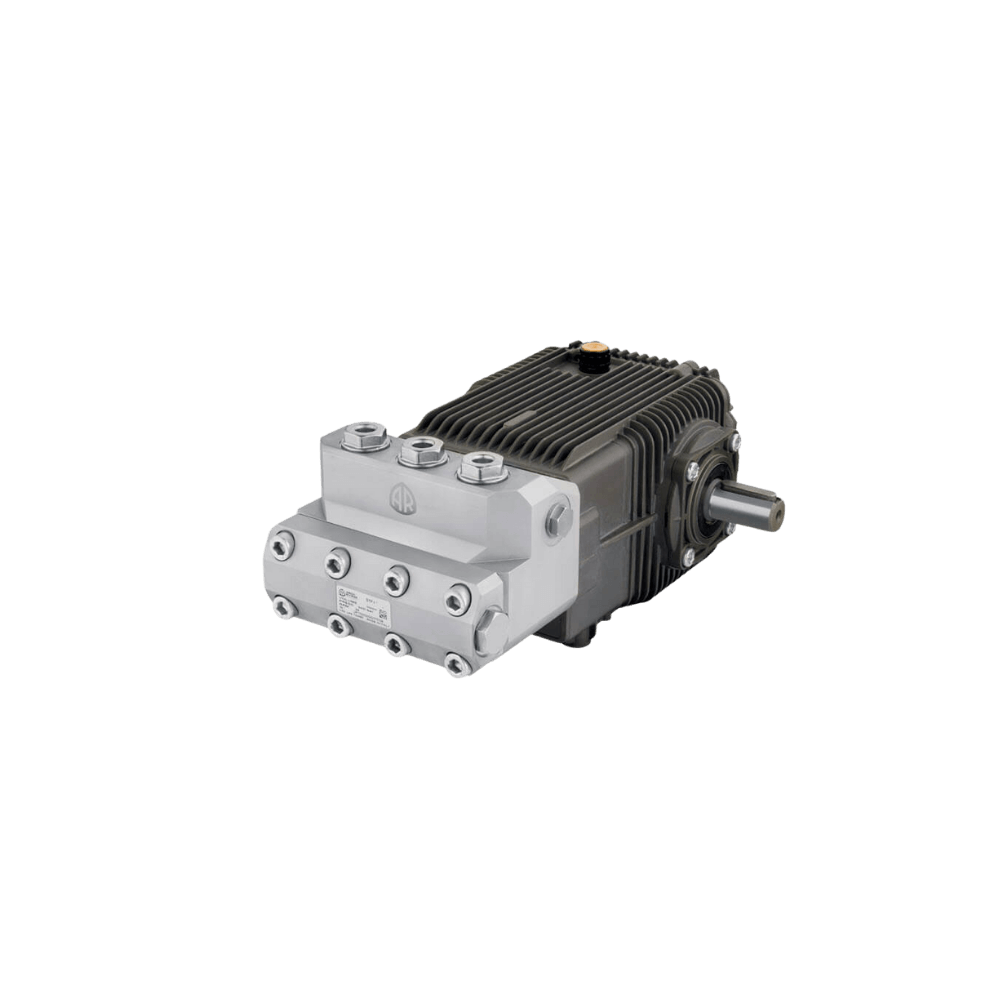
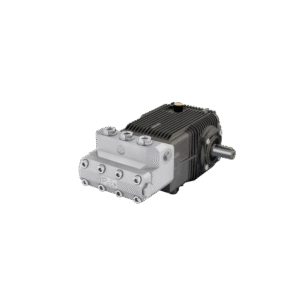
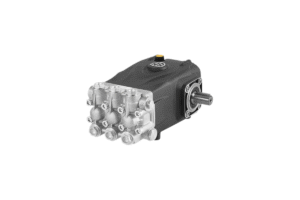
A triplex pump is a positive displacement pump with three plungers driven by a crankshaft, laid out much like a three-cylinder engine. Each plunger runs in its own bore, draws water in through an inlet check valve on the way back, and pushes it out through a discharge check valve on the way forward.
Positive displacement means it moves a fixed volume per revolution regardless of what is downstream. The pump does not make pressure on its own. It makes flow, and pressure is what happens when that flow meets a restriction, which is your nozzle. This is why nozzle size changes your pressure reading, and why the wrong nozzle can send pressure somewhere it should not go.
Why three, and why offset
The three plungers are spaced 120 degrees apart on the crankshaft. They do not move together, and that is the design.
One plunger alone would give you a hard pulse followed by nothing. Two would still leave gaps. Three offset by 120 degrees means one is always mid-discharge while another is filling, so the strokes overlap and the output smooths out. Residual pulsation on a triplex runs around 5 to 6 percent of working pressure, which you feel at the gun as a steady jet rather than a hammer.
That smoothness is not a comfort feature. Pressure pulses fatigue hoses, loosen fittings and beat up unloaders. Flatten the curve and the whole system lives longer.
What is inside a triplex pump
- Crankcase. Usually aluminum, often anodized. It holds oil and houses the crankshaft, rods and bearings. This side never sees water.
- Plungers. Ceramic on most quality pumps, solid rather than coated on the better ones. Hard enough that grit does not score them, which is what makes seals last. Also brittle, so freezing cracks them.
- Seals. The wear item. On a well-built pump they are arranged as two seals in series with a drain between, so a failing primary seal leaks onto the floor instead of into your oil.
- Head. Brass, nickel-plated brass, or stainless, depending on model. This is the part that determines your chemical compatibility, not the plungers.
- Check valves. Six of them, an inlet and a discharge per plunger. The highest-cycle parts in the pump and a common source of pressure loss when they wear.
Why people choose them
Compared with an axial cam pump, a triplex gives you longer service life, genuine rebuildability, higher available pressure and flow, and a wider range of configurations. Compared with a triplex, an axial gives you lower cost, less weight and direct mounting.
The honest way to decide is hours. A machine that runs occasionally does not justify a triplex. A machine that works every day costs less to own with one, even though it costs more to buy.
A note on materials, since it gets stated loosely: a triplex is not “made of brass or stainless steel.” The head may be. The crankcase is aluminum, the crankshaft is steel, the rods are often bronze. When someone says a pump is stainless, they mean the head and the wetted parts.
Reading a model number
AR part numbers carry most of the spec if you know the pattern. Take RKA4G40HN:
- 4G is 4 gallons per minute
- 40 is usually pressure divided by 100, so 4,000 PSI. See the caution below
- H is a hot water rating
- N is a solid shaft; E means a flange for a motor mount
Other suffixes worth knowing: SX is a left-hand shaft, SS is a stainless head, HN is nickel-plated. Flange codes such as F7, F8, F33 and F38 tell you the mounting standard. F33 is a NEMA 56C motor face; F7 and F8 are common gas engine flanges.
One caution. The flow figure and the suffixes stay reliable, but the pressure number can go stale, because AR sometimes rerates a pump without renaming it. The stainless RKA-SS family is the current example: models still called G15 and G12 are rated 3,000 PSI in the 2026 catalog. Use the model number to narrow the search, then confirm the pressure against the current listing before you size a motor around it.
Sizing a triplex pump
Start from the work, not the pump. Flow determines how fast you cover an area. Pressure determines what you can remove. Then check whether you can actually drive it:
GPM × PSI ÷ 1460 = brake horsepower at the pump shaft
Size the motor or engine 10 to 20 percent above that and round up to a standard frame. A 4 GPM, 4,000 PSI pump needs about 11 BHP, so a 13 to 15 HP engine or a 15 HP motor. This number decides more purchases than anything else on the spec sheet.
Last thing: check the RPM before you buy. Industrial triplex pumps often run at 1450 or 1000 RPM and require a belt drive or gearbox. They will not bolt to a 3400 RPM gas engine, and running a slow pump fast destroys it quickly.
Browse pressure washer pumps or complete pump packages. If you have a machine you are trying to match, send us the model and shaft details and we will find the right part number. Contact us here.