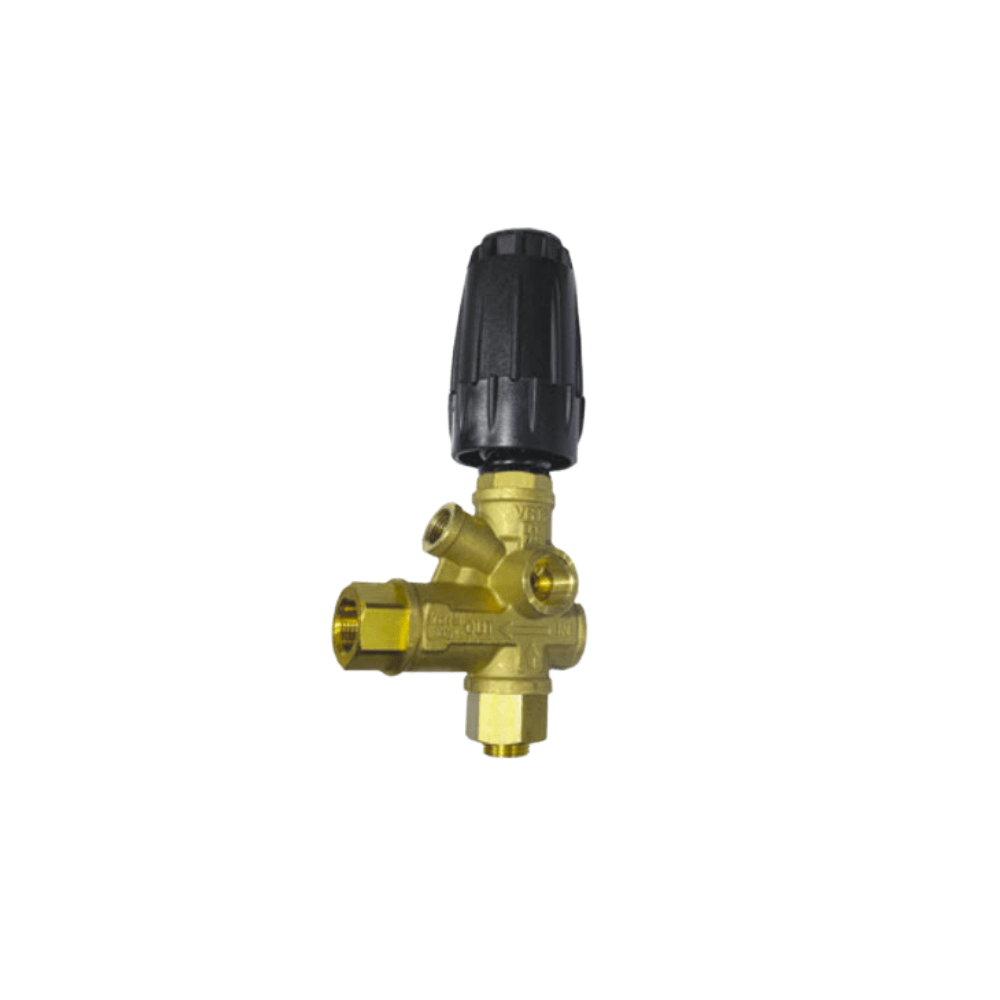
Release the trigger on a running pressure washer and the pump does not stop. It keeps displacing water against a closed gun, and pressure spikes instantly. The unloader valve is what catches that spike and routes the flow into bypass instead of letting the pump deadhead.
Without one, heat climbs, seals burn, and valves crack. A pump can be ruined in the time it takes to walk to the next car. With a healthy one, the operator can stop whenever they want and the pump idles safely.
Gymatic 3/B and Mini-Matic 4/B are not a ladder
This is the part that trips people up. The names suggest the 4/B is the bigger valve. On pressure, it is the opposite.
Gymatic 3/B
Mini-Matic 4/B
Pressure rating
3,650 PSI
2,600 PSI
Flow
Mid-range AR plunger pumps
2 to 5 GPM
Mounting
Bolts to the pump manifold via banjo bolts
External brass body with bypass port
Adjustment
Cartridge style, single access point
Hand knob
Injector
Optional integrated
Fixed or adjustable orifice versions
Best fit
Compact OEM frames, tight plumbing
Contractor rigs, field service, soap injection
So the choice is about pressure first, then plumbing. If your system runs above 2,600 PSI, the Mini-Matic is out regardless of how convenient the hand knob is.
Gymatic 3/B
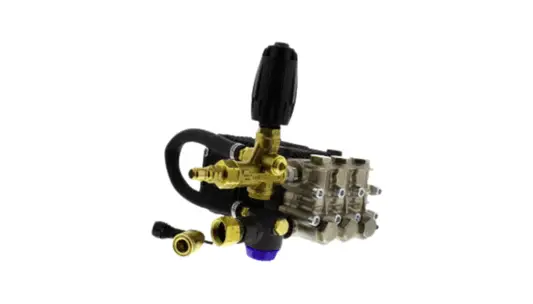
The AR20477 Gymatic 3/B is rated 3,650 PSI and bolts straight to the pump manifold. No external fittings, no hose run between pump and regulator, which is why OEMs like it on tight frames.
Two practical advantages. Mounting on the manifold means the valve sees pressure changes immediately, so bypass transition is smooth and the gun kicks less. And service is a cartridge swap from one access point rather than breaking plumbing.
Mini-Matic 4/B
Rated 2,600 PSI, 2 to 5 GPM, forged brass body with an external bypass port. There are several versions and the difference between them is mostly the injector:
AR20821-PKG, the complete package with garden hose adapter and filter, 2,600 to 2,800 PSI
Pick by orifice if you are injecting chemical. The injector size sets draw rate, and swapping the unloader to change soap draw is a common and avoidable mistake.
Above 3,650 PSI
Neither of these covers a 4,000 PSI contractor rig. For that range the VR35 3/B package is rated 4,200 PSI, and the VRT and VHP families go higher still. Match the valve rating to the pump rating with margin, never the other way around.
Setting up an unloader
Start from the pump’s rated PSI and GPM. The unloader cannot make a pump safe above its own rating, and it cannot make a pump exceed its own.
Set pressure with the trigger open, then close the trigger and confirm bypass behavior. Setting it closed gives you a number that means nothing in use.
Route bypass with smooth bends and adequate hose ID. A restricted bypass line makes a good valve behave like a bad one.
Add thermal relief. Bypass water heats fast. The unloader protects against pressure; the thermal relief valve protects against temperature. They are different jobs.
Mount close to the pump. Distance adds lag, and lag shows up as spikes.
Lock the setting with the jam nut or cap so vibration cannot walk it.
Four symptoms and what they mean
Pressure spikes then drops off. Worn seat or spring in the cartridge. Replace the cartridge kit, and while you are there check that the bypass route is not restricted and the valve is not mounted halfway down the frame.
Water weeping at the adjustment knob. Failed internal seal. Replace the O-ring kit and inspect the spindle for scoring, because a scored spindle will eat the new seal too.
Pump overheats at idle. Extended bypass with no flow through the system. Fit a thermal relief valve, shorten the bypass loop, or have the operator cycle the trigger more often.
Valve hunts or chatters. Usually air ingestion or a clogged inlet, sometimes an oversized nozzle. Bleed the air, clean the filters, and verify the nozzle orifice matches your GPM and PSI before touching the unloader setting.
Unloader maintenance
Inspect O-rings and joints for dampness under pressure. Any weep is a service item.
Flush with clean water after detergent. Residue scores seats.
Replace the cartridge at the first chatter or wandering pressure, not after it fails.
Check springs annually. Corroded or weakened springs cause erratic behavior that gets blamed on the pump.
Keep the inlet screen clean. Debris shortens unloader life as fast as it shortens pump life.
AR publishes exploded diagrams and kit part numbers for both valves, so rebuilding is usually cheaper and faster than replacing. Keeping one cartridge kit and one seal kit on the shelf turns a dead rig into a twenty-minute repair.
The Honda GX200 is a small engine, and the mistake people make with Honda GX200 pump packages is buying a
Manage Consent
To provide the best experiences, we use technologies like cookies to store and/or access device information. Consenting to these technologies will allow us to process data such as browsing behavior or unique IDs on this site. Not consenting or withdrawing consent, may adversely affect certain features and functions.
Functional
Always active
The technical storage or access is strictly necessary for the legitimate purpose of enabling the use of a specific service explicitly requested by the subscriber or user, or for the sole purpose of carrying out the transmission of a communication over an electronic communications network.
Preferences
The technical storage or access is necessary for the legitimate purpose of storing preferences that are not requested by the subscriber or user.
Statistics
The technical storage or access that is used exclusively for statistical purposes.The technical storage or access that is used exclusively for anonymous statistical purposes. Without a subpoena, voluntary compliance on the part of your Internet Service Provider, or additional records from a third party, information stored or retrieved for this purpose alone cannot usually be used to identify you.
Marketing
The technical storage or access is required to create user profiles to send advertising, or to track the user on a website or across several websites for similar marketing purposes.