Hot water does the heavy lifting on grease, but the same heat that lifts it also destroys pumps. Seals warp, O-rings crack, valves fail. The thermostat is the part standing between those two outcomes, and it costs almost nothing compared to what it protects.
What a thermostat does
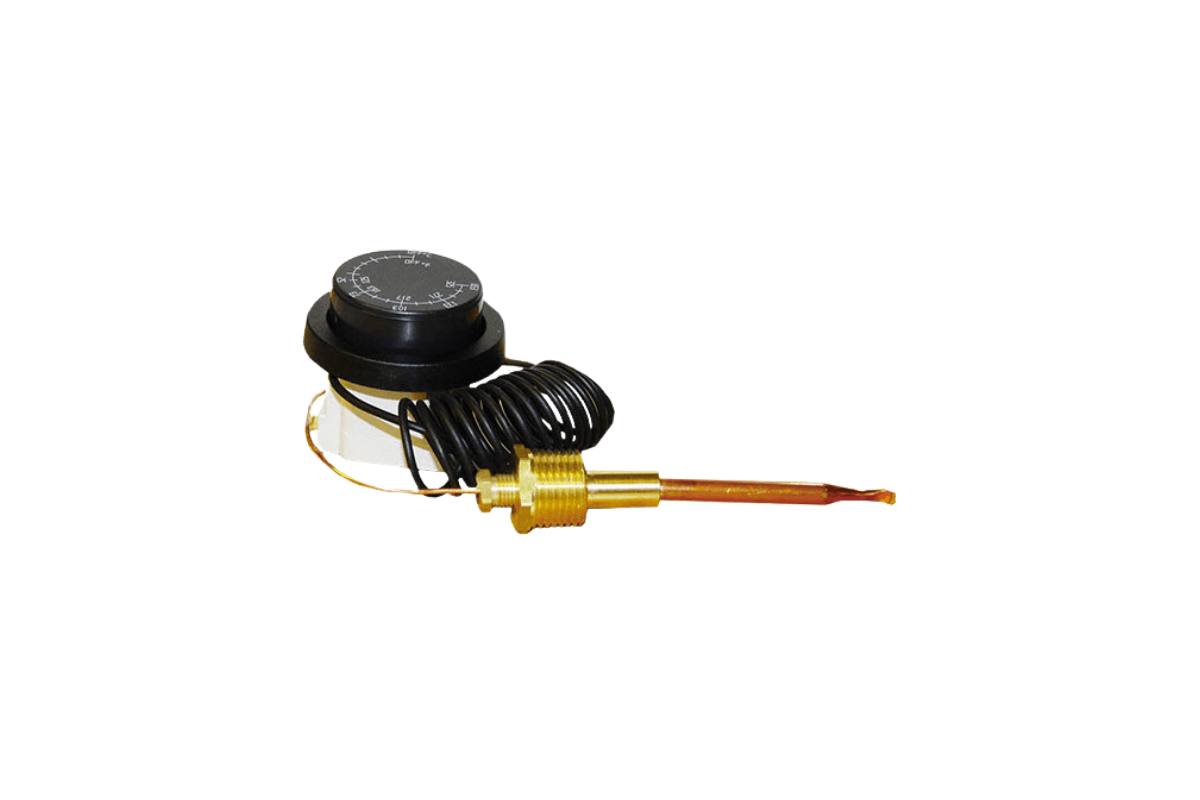
A capillary thermostat senses water temperature through a probe in the flow path and opens a circuit when the water passes a set limit, shutting down the burner or the machine. The probe sits in the water, a long capillary tube carries the signal, and the switch body mounts somewhere cooler and reachable.
Without one, a hot water system has no upper bound. The burner keeps firing, and if the operator releases the trigger and the water sits in bypass, temperature climbs quickly past anything the seals were designed for.
Both use copper capillaries and double-walled construction. The only real difference is where the cutoff sits.
Which thermostat to choose
Choose the cutoff to sit above your working temperature and below your pump’s rating. That sounds obvious and it is where most people get it wrong in one of two directions.
GTLU3040, off at 250°F. For systems that genuinely run hot: restaurant hood and duct work, industrial plant grease, oilfield machinery. Only fit this if your pump and seals are rated for the range underneath it.
GTLU3044, off at 190°F. For the majority of hot water work: car washes, fleet cleaning, general contracting, and any pump rated 185°F inlet. If your pump’s ceiling is 185°F, a 250°F cutoff will not protect it. This is the more common right answer.
Set the cutoff by the weakest component in the system, not by the hottest number you would like to reach.
Installing a thermostat
Probe placement. It has to sit where the water temperature is representative, which usually means downstream of the heat exchanger in the flow path, not in a dead leg. A probe in a pocket of still water reads the wrong number and shuts down late.
Capillary routing. Seventy inches lets you mount the switch body well away from the heat, which it needs. Route it in a gentle arc without kinks, because a kinked capillary is the most common failure on these.
Electrical. Rated 20 A at 250 V, which covers standard burner and contactor circuits. Wire it as a series interrupt so a failure opens the circuit rather than closing it.
Calibration. Set the cutoff during commissioning and verify it with an actual measurement, not the dial marking.
Three symptoms and what they mean
Shutoff is inconsistent. Check the capillary for kinks or crush damage along its whole length, including where it passes through a panel.
No temperature control at all. Verify probe placement first, then electrical continuity. A probe that has worked loose reads the air around it.
System overheats even though the thermostat is fitted. Replace the unit immediately, and inspect the pump seals before running again. If the thermostat let it overheat once, the damage has already started.
Routine thermostat checks
Inspect the capillary for kinks and abrasion where it passes through panels
Check electrical contacts for corrosion, which is common in a wet environment
Confirm the probe is still seated and in the flow
Verify the actual cutoff temperature annually rather than trusting the dial
Where hot water thermostats matter most
Restaurant hood and duct cleaning: the job needs heat, and the enclosed space makes an overheating failure dangerous
Fleet maintenance: diesel residue and road grime lift with steady heat, and steady is the operative word
Food processing and USDA facilities: regulated temperatures are part of the sanitation record, not just equipment protection
Heavy equipment cleaning: long sessions with frequent trigger pauses, which is exactly when bypass heat builds
Municipal contracts: gum and graffiti removal with controlled hot water
One thing a thermostat does not replace
A thermostat protects against a heater running away. A thermal relief valve protects against bypass water heating with no heater involved at all. They are different failure modes and you want both on a hot water system.
The Honda GX200 is a small engine, and the mistake people make with Honda GX200 pump packages is buying a
Manage Consent
To provide the best experiences, we use technologies like cookies to store and/or access device information. Consenting to these technologies will allow us to process data such as browsing behavior or unique IDs on this site. Not consenting or withdrawing consent, may adversely affect certain features and functions.
Functional
Always active
The technical storage or access is strictly necessary for the legitimate purpose of enabling the use of a specific service explicitly requested by the subscriber or user, or for the sole purpose of carrying out the transmission of a communication over an electronic communications network.
Preferences
The technical storage or access is necessary for the legitimate purpose of storing preferences that are not requested by the subscriber or user.
Statistics
The technical storage or access that is used exclusively for statistical purposes.The technical storage or access that is used exclusively for anonymous statistical purposes. Without a subpoena, voluntary compliance on the part of your Internet Service Provider, or additional records from a third party, information stored or retrieved for this purpose alone cannot usually be used to identify you.
Marketing
The technical storage or access is required to create user profiles to send advertising, or to track the user on a website or across several websites for similar marketing purposes.