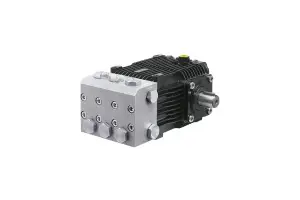
Most hydraulic pump installations that fail do not fail at the pump, which is the argument for an AR hydraulic base kit. They fail at the coupling, because the pump and the motor were never truly in line. A shop-fabricated plate looks square, bolts up fine, and then eats a coupler every few months while everyone blames the motor.
AR’s hydraulic base kits are pre-drilled steel plates that put the pump and motor where they belong. Three sizes, matched to specific pump and motor combinations.
14 x 19 in, welded rib supports, cast iron motor mount
XW, SXW
HYDM329M, HYDM390M, HYDM433M
L100 flex
HYDBK1
The compact one. Rubber feet for vibration isolation, which matters on a trailer or a service body where the whole frame moves. Right for portable skids and mobile washers where footprint and weight are the constraint.
HYDBK2
Same plate size as the HYDBK1 but drilled for L095 flex coupler mounts. The flex coupler is the reason to choose it: it absorbs the small misalignment that always exists in a real installation and takes that load off the pump and motor shafts instead of putting it into the bearings.
HYDBK4
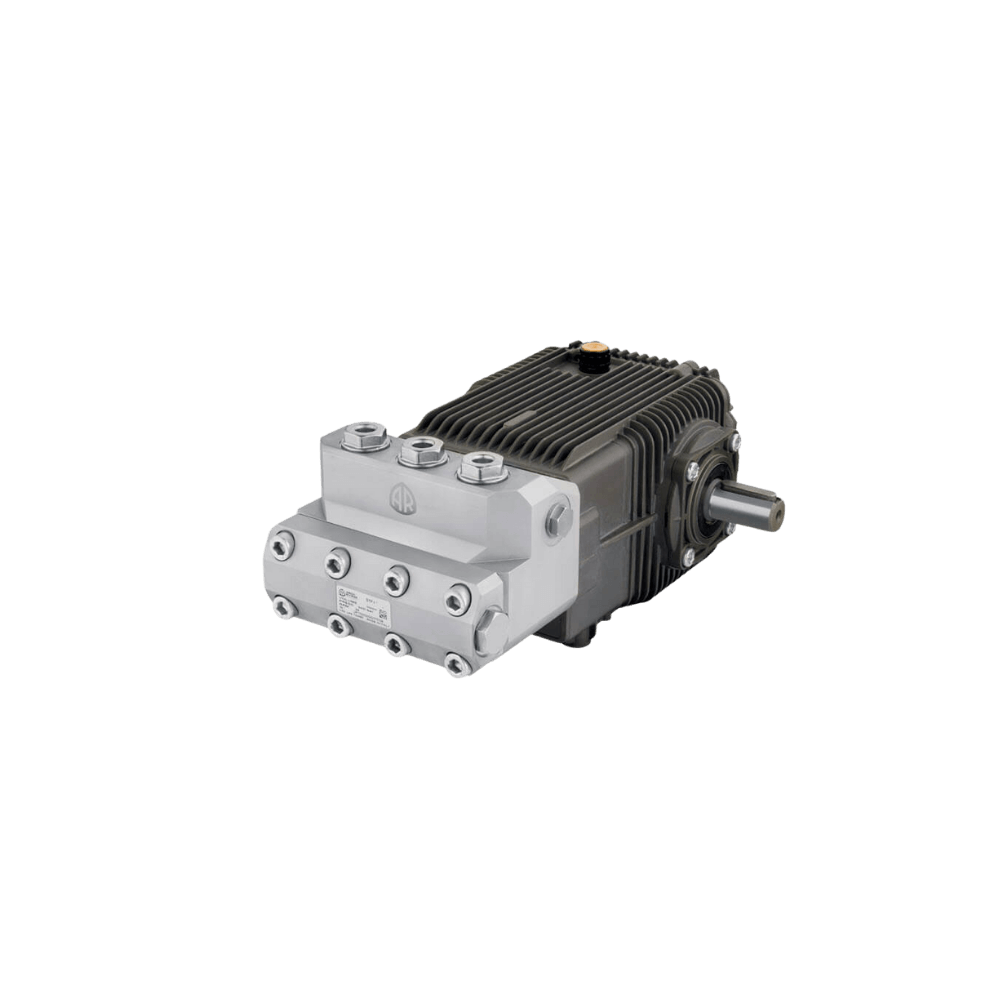
The heavy one. Larger plate, welded rib supports so it does not flex under torque, cast iron motor mount, and an L100 coupler for the higher load. This is what goes under XW and SXW pumps on continuous-duty municipal and industrial rigs.
Why the plate matters more than it looks
A hydraulic motor and a triplex pump have to share a centerline. Misalignment shows up as a cyclic side load on both shafts, once per revolution, for every hour the machine runs. The coupler absorbs some of it and then fails. What it does not absorb goes into the bearings.
A pre-drilled base fixes the geometry at the factory. You are not measuring, not shimming, and not discovering three months later that the plate was a sixteenth out.
The secondary benefit is time. Fabricating and drilling a plate is most of a day. Bolting down a finished one is twenty minutes.
Installing a hydraulic base kit
Check alignment anyway. The plate gets you very close, but a straightedge across the coupling halves costs nothing and catches a bent shaft or a burr under a foot.
Use the specified coupler. L095 on the HYDBK2, L100 on the HYDBK4. A coupler sized by horsepower alone will be undersized, because these pumps run slow and slow means high torque.
Bolt the base to something rigid. A stiff plate on a flexing frame is still a flexing installation.
Torque the fasteners to spec and re-check them after the first few hours of running.
Inspect quarterly. Loose bolts and a worn coupler spider are what you are looking for. Both are cheap if you catch them.
Keep it clean. Zinc plating resists corrosion but does not enjoy sitting under wet detergent.
Where AR hydraulic base kits are used
Hydro excavation trucks, sewer jetting fleets, industrial wash skids, trailer-mounted contractor rigs, and washdown systems on construction and mining equipment. Anywhere the machine already carries hydraulics and the pump has to survive vibration it did not ask for.
The Honda GX200 is a small engine, and the mistake people make with Honda GX200 pump packages is buying a
Manage Consent
To provide the best experiences, we use technologies like cookies to store and/or access device information. Consenting to these technologies will allow us to process data such as browsing behavior or unique IDs on this site. Not consenting or withdrawing consent, may adversely affect certain features and functions.
Functional
Always active
The technical storage or access is strictly necessary for the legitimate purpose of enabling the use of a specific service explicitly requested by the subscriber or user, or for the sole purpose of carrying out the transmission of a communication over an electronic communications network.
Preferences
The technical storage or access is necessary for the legitimate purpose of storing preferences that are not requested by the subscriber or user.
Statistics
The technical storage or access that is used exclusively for statistical purposes.The technical storage or access that is used exclusively for anonymous statistical purposes. Without a subpoena, voluntary compliance on the part of your Internet Service Provider, or additional records from a third party, information stored or retrieved for this purpose alone cannot usually be used to identify you.
Marketing
The technical storage or access is required to create user profiles to send advertising, or to track the user on a website or across several websites for similar marketing purposes.