Choosing the pump is the easy part. Choosing a pump drive is what decides noise, fuel burn, seal life, footprint and how often someone is out there with a wrench.
There are five realistic options. Each is right for a specific situation and wrong for the others.
1. Direct-coupled electric
The pump shaft couples straight to an electric motor. Compact, efficient, quiet, and the fewest wear parts of any option. Add a VFD for soft start, adjustable speed and real energy savings.
Right for: fixed installations, indoor plants, sanitary environments, anywhere noise and footprint matter.
The catch: motor speed must match the pump’s rated RPM. A 1,750 RPM pump on a 1,750 RPM motor is a direct couple; a 1,450 RPM pump is not, and no amount of coupling solves that. Use a bell housing and flexible coupling where alignment is awkward or vibration is a concern, because a rigid coupling transmits every misalignment straight into the bearings.
The skid systems are this configuration, already built and aligned.
2. Belt drive
Motor or engine drives the pump through belts and pulleys on rails.
Right for: long duty cycles, hot water skids, and any time you want the pump turning slower than the drive.
That last point is the real argument. Running a pump at 1,000 RPM off a 1,750 RPM motor roughly halves the wear cycles per hour and drops the friction heat with them. Belts also isolate the pump mechanically from the drive, and changing the ratio is a matter of swapping a sheave.
The catch: alignment. Use rail kits sized to your pump family and check tension on a schedule. Misalignment produces hot bearings and short seal life, and it is invisible until something fails.
3. Gearboxes
A sealed reducer between engine and pump, achieving target RPM without belts.
Right for: engine-driven sets that want belt-drive durability in a smaller, enclosed package, especially where a belt guard is impractical or a belt would collect debris.
The catch: the ratio is fixed, and reducers must be sized for torque at the shaft rather than horsepower alone. At low output speeds, torque is what breaks things. Confirm the flange pattern and shaft form: 1 in keyed, 24 mm, splined and F-series flanges are all different.
4. Electric clutch
A 12 V electromagnetic clutch disengages the pump until the trigger is pulled, so the engine idles without driving it.
Right for: gas and diesel skids, mobile rigs, and stop-and-go crews.
The savings are real: less fuel, less noise, easier starts with no load on the engine, and much less heat and seal wear in bypass. On a residential crew moving between houses, the pump might be actually cleaning for less than half the shift.
Several pumps ship with clutch drive already fitted, which is simpler than adding one: RKV4G35HD-F24CL at 4 GPM / 3,500 PSI, RKA4G30N-EC at 4 GPM / 3,000 PSI, RG1528HN-EC at 4 GPM / 4,000 PSI, RG2125HN-EC at 5.5 GPM / 3,650 PSI, and XMA3G25N-EC at 3 GPM / 2,500 PSI with a 7 in pulley.
5. Hydraulic drive
A hydraulic motor turns the pump, taking power from a circuit the machine already has.
Right for: vac trucks, sewer jetters, hydrovac, municipal fleets, OEM skids, and remote installations where hydraulics are plentiful and electricity is not.
The catch: the hydraulic specification is the real constraint. Match motor displacement and torque to the pump’s rated RPM and pressure, and check your circuit’s flow at working temperature, not the brochure figure. Verify return and case-drain requirements before plumbing anything.
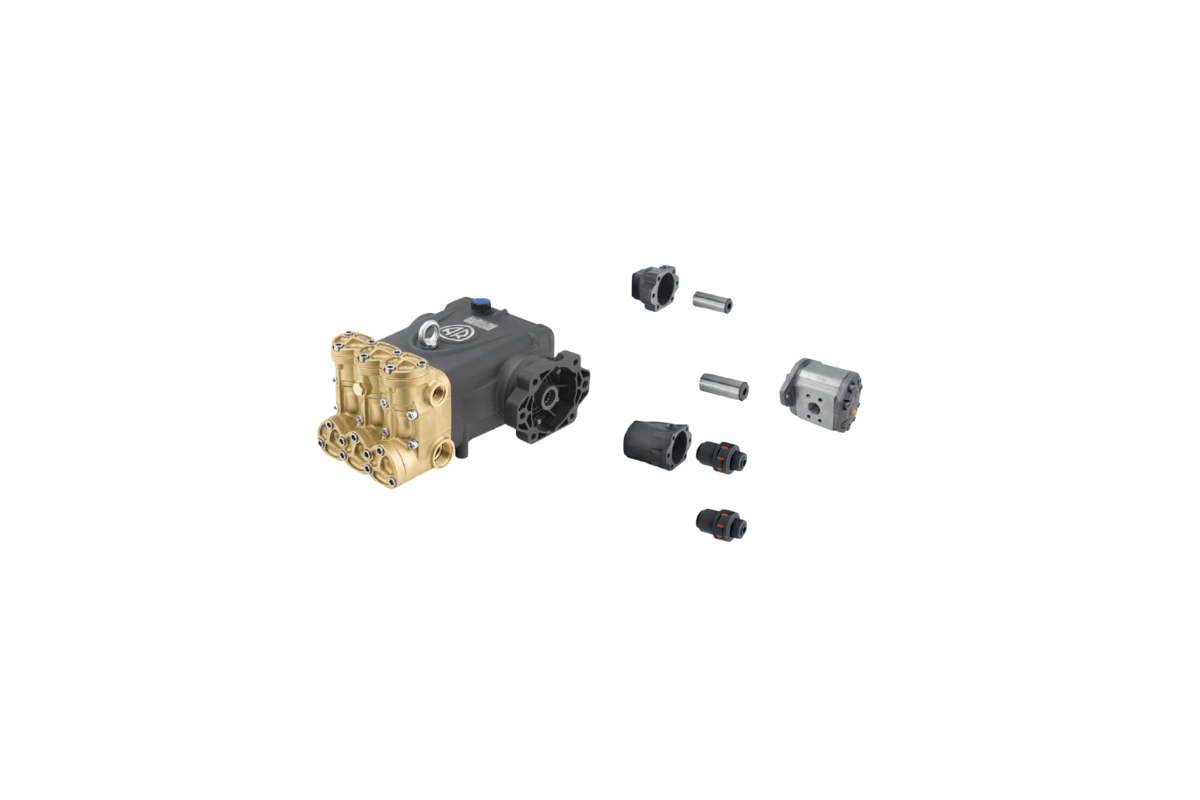
The hydraulic motor range and the HYDBK base kits cover the mounting, which is where hydraulic builds usually go wrong.
Choosing a pump drive: five questions that narrow it
- What is your power source? Electric, engine or hydraulic. This eliminates most options immediately.
- What is the duty cycle? Continuous, hot or chemical duty favours belt drive and slower pump speeds.
- Do you need reduction? Compare your drive speed to the pump’s rated RPM. If they differ, you need pulleys or a gearbox, not a coupling.
- How much of the shift is the trigger actually open? If it is under half, a clutch pays for itself.
- How will it be mounted and serviced? Rails, guards, and access for belt tension or gearbox oil changes.
Three builds that work
Plant skid: VFD motor, direct coupling through a bell housing and flex coupling. Quiet, clean, minimal service.
Contractor hot water rig: engine, belt drive on rails, electric clutch. Cool running, low fuel burn, long seal life.
Municipal truck: hydraulic motor on a matched base kit to an RK, RTX or RTD pump. Simple plumbing, high torque, tidy packaging.
Three mistakes with pump drives
- Running the pump too fast. Match rated RPM. Overspeeding shortens seal life dramatically and voids warranty.
- Skipping alignment hardware. Rails and housings are not optional extras. Misalignment is the leading cause of premature bearing and seal failure.
- No idle strategy on engine sets. Hours of full-RPM operation with the trigger closed, burning fuel and heating bypass water.
Browse power transmission components, or tell me your pump model and power source and you will get a drive configuration rather than a list of options.