A public works department maintains miles of laterals, storm lines and culverts on a budget set years in advance. The economics of that are simple: clearing a line with a nozzle costs a fraction of excavating it, and the cost of not clearing it is a flooded intersection.
Sewer nozzles are where that maintenance actually happens. Here is how to specify them for municipal work.
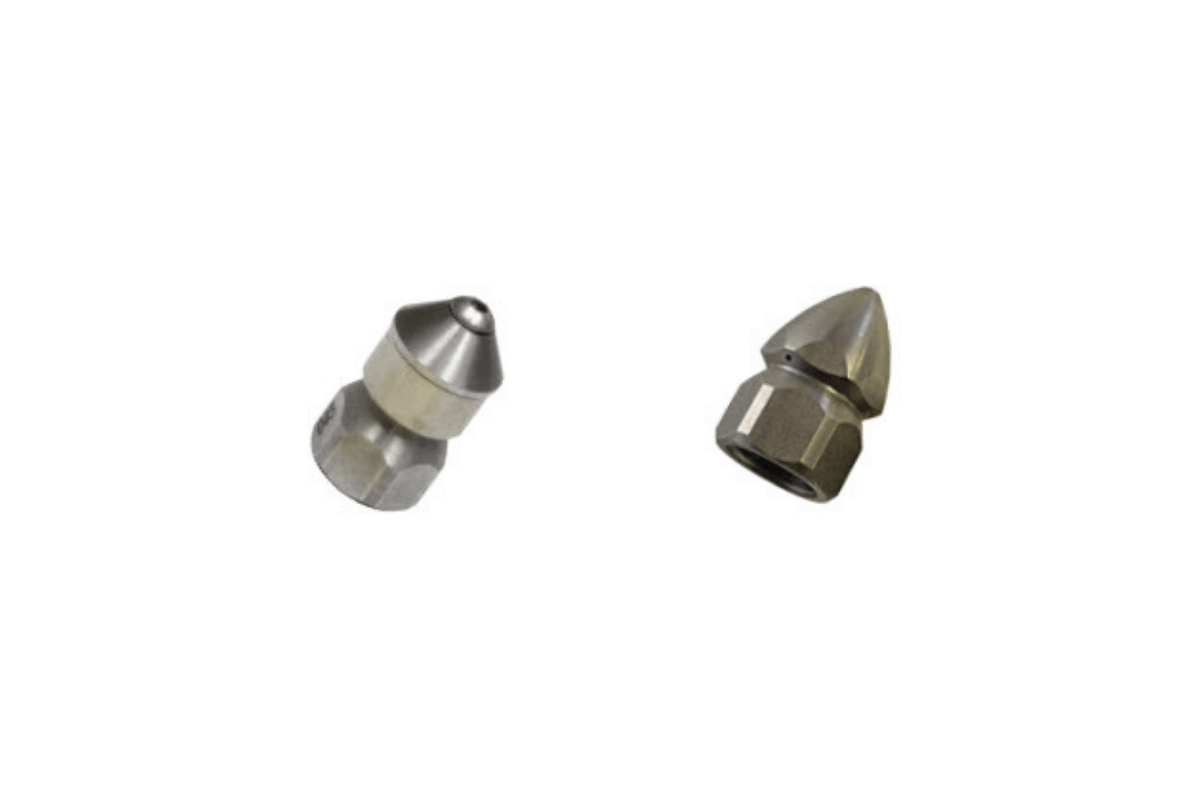
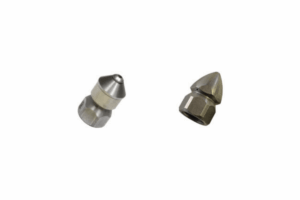
All are rated 4,350 PSI, with nickel-plated steel bodies, stainless nipples and ceramic tips. Nozzle bodies are available separately: SNA1, SNA2, SNA3 and SNA4.
Thrust or cutting
Every jetting nozzle splits its water between rear jets, which push the hose up the line, and forward jets, which attack the blockage. The split is the specification that matters.
Grease and sediment flush downstream. Favour rear-jet thrust: get the nozzle past the deposit and wash it out on the way back.
Roots and hard scale have to be cut. Favour forward jets.
Long runs need more thrust regardless, because the nozzle has to drag more hose.
Carrying both types is how crews avoid the second trip.
Municipal applications
Storm drain clearing. Leaves, sand and street debris overwhelm drains in heavy rain. Clearing them before a storm is the cheapest flood mitigation a city can do.
Lateral maintenance. Residential and commercial laterals clog with grease and roots. A jetted lateral restores flow without excavation, and preventative programmes catch them before the backup.
Industrial zones. Food processing, chemical facilities and restaurant districts generate recurring grease and sludge. Regular jetting keeps those lines compliant.
Root control. Rotating ceramic-tip nozzles shave intrusions and restore flow until a permanent repair is scheduled. On older infrastructure this is the difference between a maintenance line item and a capital project.
Hot water and grease
Grease is the most common blockage in commercial districts and it responds to heat far better than to pressure, so a lot of this work is done hot. These nozzles are rated to 320°F, so hot water is well inside what they will take. The limit is usually somewhere else in the line: check that every hose and fitting between the pump and the nozzle carries a rating to match.
Operator safety with sewer nozzles
High-pressure jetting is more hazardous than surface cleaning because the working end is invisible. Crews need training in:
Pressure and flow matching, so nozzles behave predictably
Hose handling and whip prevention, and never retrieving a running nozzle to the entry point, because it can reverse and exit at the operator
Confined space entry for manholes and vaults
PPE standards for high-pressure water
Emergency shut-off, which is what a foot control valve provides without the operator letting go of the hose
The maintenance case
The argument for a nozzle programme is straightforward and it is the one to make to a council: fewer emergency call-outs during storms, longer service life on pipes and culverts, lower liability from flooding incidents, fewer resident complaints about backups, and capital repairs deferred rather than triggered.
It is also a water-based method rather than a chemical one, which matters where environmental policy applies.
Equipping a fleet
Carry more than one size. A crew with only 1/2 in nozzles cannot service a residential lateral, and a crew with only 1/4 in nozzles wastes a day on a storm main. Two or three sizes in each thrust configuration covers almost everything a public works department encounters.
The Honda GX200 is a small engine, and the mistake people make with Honda GX200 pump packages is buying a
Manage Consent
To provide the best experiences, we use technologies like cookies to store and/or access device information. Consenting to these technologies will allow us to process data such as browsing behavior or unique IDs on this site. Not consenting or withdrawing consent, may adversely affect certain features and functions.
Functional
Always active
The technical storage or access is strictly necessary for the legitimate purpose of enabling the use of a specific service explicitly requested by the subscriber or user, or for the sole purpose of carrying out the transmission of a communication over an electronic communications network.
Preferences
The technical storage or access is necessary for the legitimate purpose of storing preferences that are not requested by the subscriber or user.
Statistics
The technical storage or access that is used exclusively for statistical purposes.The technical storage or access that is used exclusively for anonymous statistical purposes. Without a subpoena, voluntary compliance on the part of your Internet Service Provider, or additional records from a third party, information stored or retrieved for this purpose alone cannot usually be used to identify you.
Marketing
The technical storage or access is required to create user profiles to send advertising, or to track the user on a website or across several websites for similar marketing purposes.