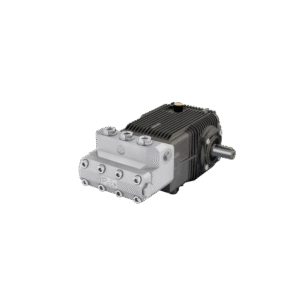
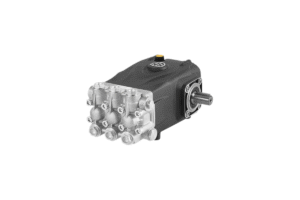
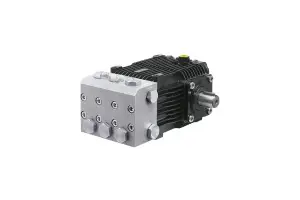
Hot water is the cheapest upgrade in pressure washing, and WHWL hot water pumps are how you get it at volume. It drops the viscosity of oil and grease so detergent can get underneath, it cuts dwell time because chemistry moves faster warm, and it rinses without the re-deposition that leaves streaks on a cold wash.
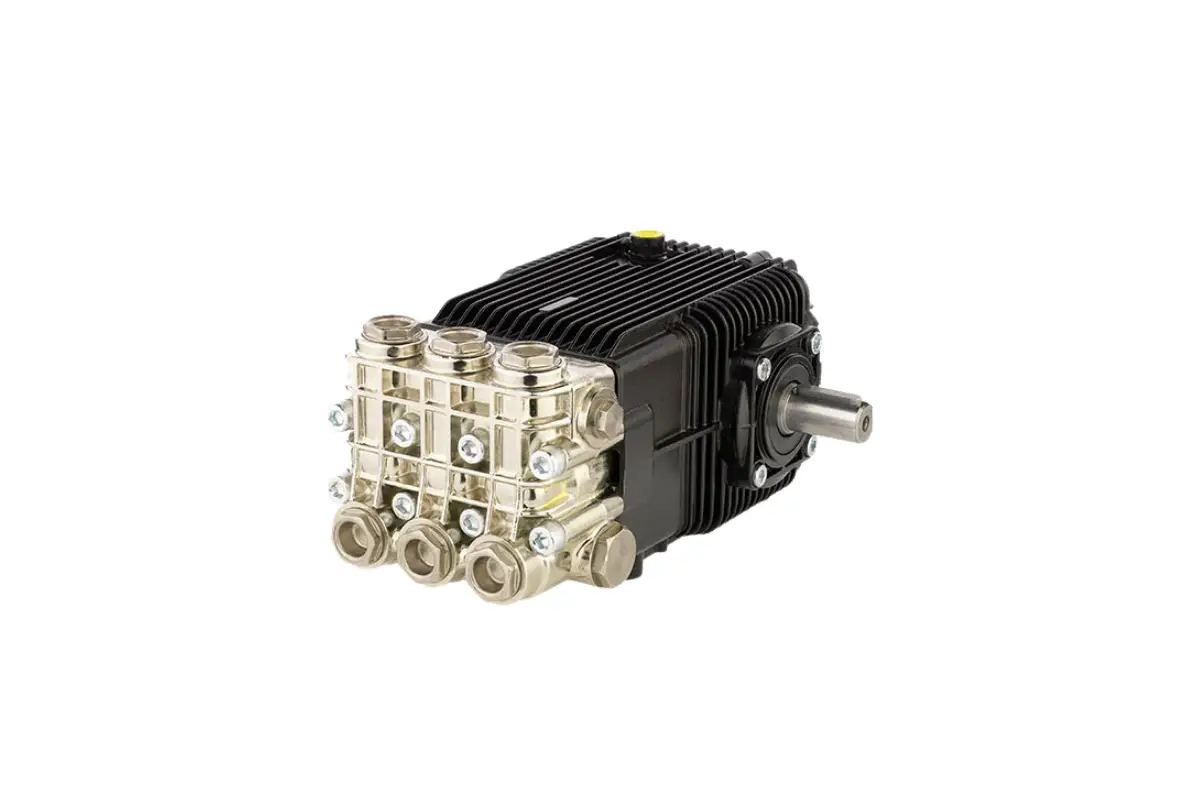
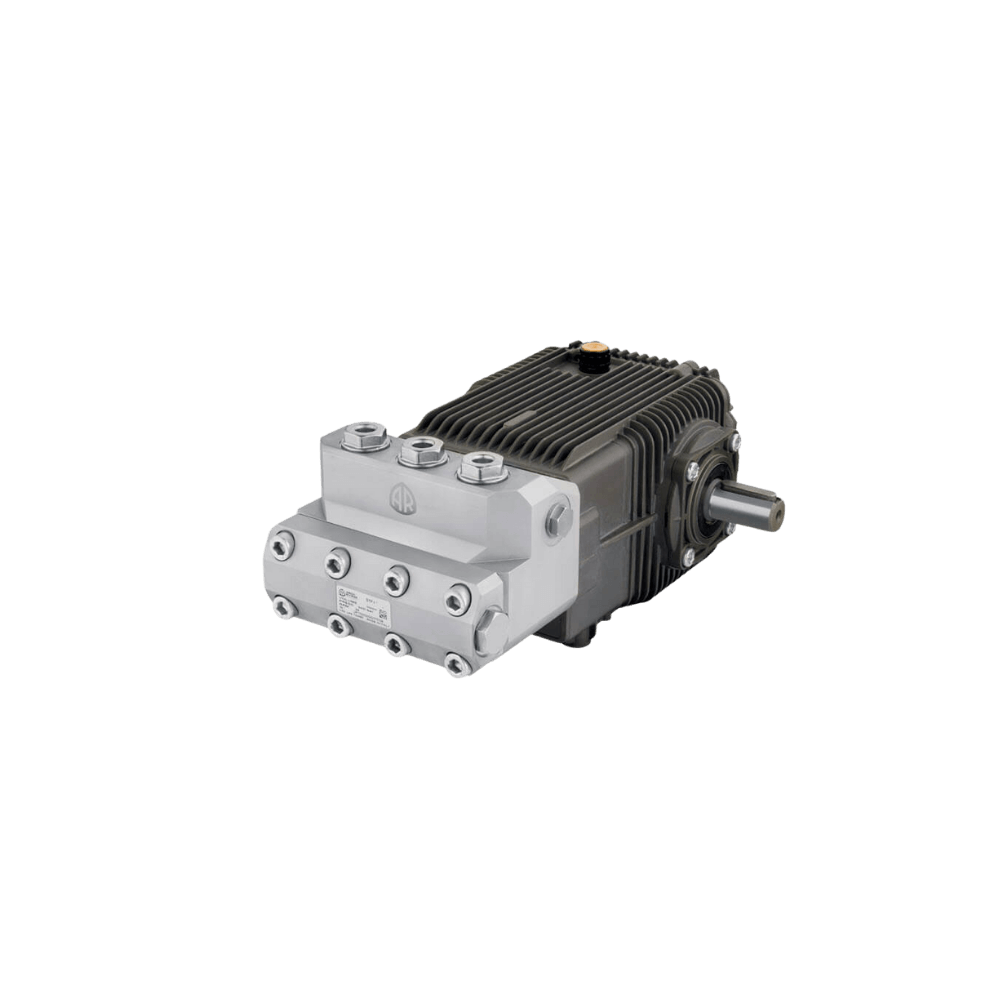
The catch is that heat is hard on pumps. Seals stiffen, oil thins, and a pump that runs fine at 60°F inlet will chew through water seals at 180°F. The WHWL series is AR’s answer to that: nickel-plated brass heads, bronze connecting rods, stainless plungers, and a 32 oz crankcase that holds enough oil to carry the heat away.
All three run at 1,450 RPM on a 24 mm solid shaft, with 3/4 in F inlet and 3/8 in F discharge. The choice between them is simpler than it looks: 38 or 50 is the size, and NB gets you bronze connecting rods for the hardest continuous-duty work.
Sizing a motor for WHWL hot water pumps
EBHP is GPM times PSI divided by 1,460. The 38.15N needs 14.8 HP at the shaft, the 50.15N and 50.15NB need 19.9. Add 10 to 20 percent for hose length, elevation, ambient heat and accessory losses, then round up to the nearest standard frame. That lands you on 20 HP and 25 HP respectively. Undersizing here is the most common way a hot water rig fails to hit its rated pressure.
Plumbing a hot water system so it lasts
Most WHWL failures are not pump failures. They are inlet failures.
What WHWL hot water pumps need from your water supply
Hot water flashes to steam if you restrict it. Keep the suction line short, straight and full bore, use full-flow ball valves rather than gate valves, and skip the tight elbows. Then check the honest capacity of your heater or plate exchanger: it has to hold 180°F while delivering 9.8 or 13.2 GPM, not just at idle.
Filtration for WHWL hot water pumps
Oversize the in-line inlet filter. Hot water plus grit scores valve seats faster than either does alone, and if you run reclaim water you are feeding the pump fines continuously.
Unloader and bypass
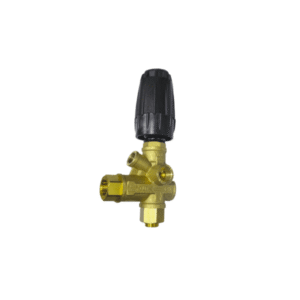
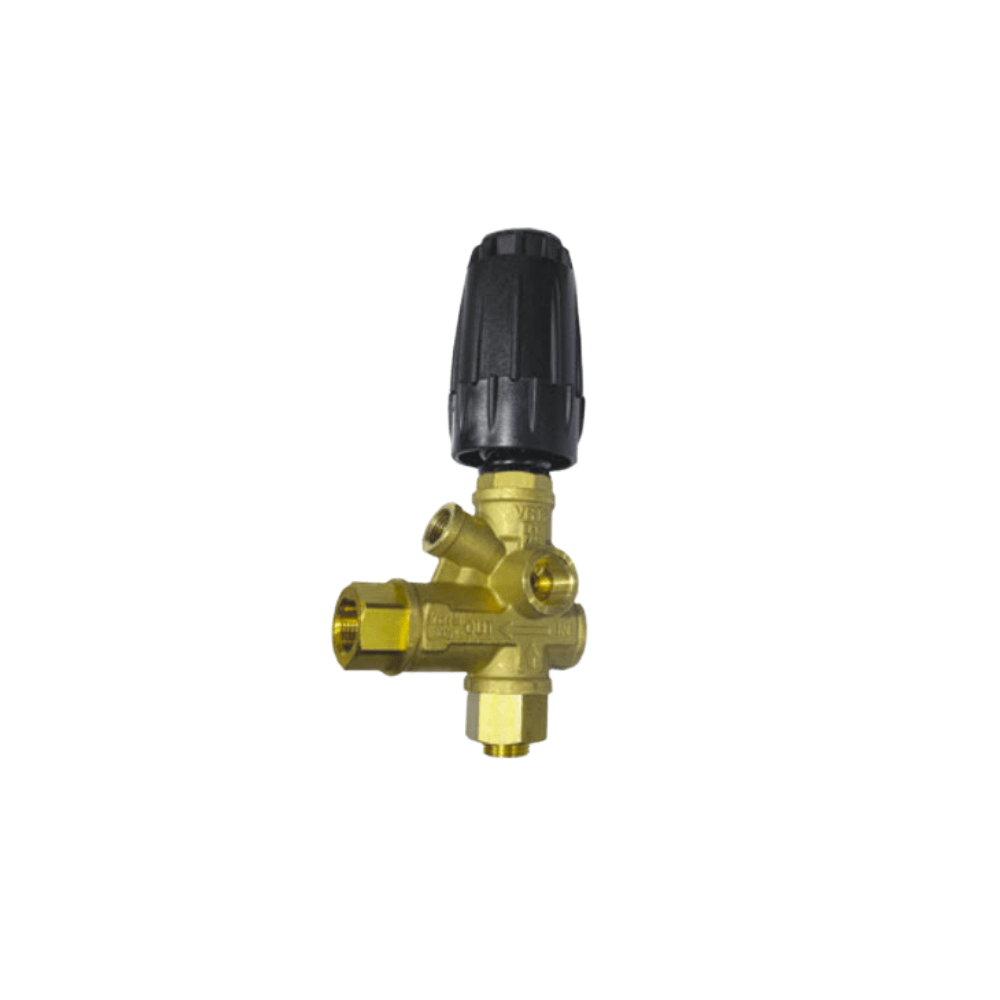
Mount the unloader close to the pump so it responds quickly. On hot water, route the bypass back to the tank rather than to the pump inlet. Recirculating bypass on a hot system stacks heat on heat, and the pump climbs past its seal rating while the operator is standing there with the trigger released. Add a thermal relief valve as a backstop.
Everything downstream
Pressure ratings drop with temperature. A hose rated 3,000 PSI cold is not rated 3,000 PSI at 180°F. Confirm hoses, guns, swivels and fittings at your working temperature, and use Viton or another high-temp elastomer where the seal contacts hot water.
WHWL pump service parts and habits
The common wear items on this platform are the stainless valve set, the 28 mm piston assemblies, the Viton water seals, the oil seals, and the support rings. Kits are model specific, so check the part against your MPN before you order.
The habits matter more than the parts:
First oil change at about 50 hours, then on AR’s interval. Milky oil means water is getting past the seals, and that is a fix-now problem, not a next-week problem.
Flush detergent out with clean water at end of shift. Sitting chemical does its damage overnight.
Look for weeping at joints while the system is pressurized. A damp fitting is an O-ring telling you it is nearly done.
Listen to the pulsation. A change in rhythm is usually valves, and valves are cheap compared to what follows them.
Run pump saver before any storage where it could freeze.
Where WHWL earns its place
Fleet and transit yards, where hot water is the only thing that lifts road grime and brake dust in one pass. Dairy parlors, barns and pens. Food processing and packing lines running sanitation programs. Industrial floors carrying cutting fluid and process oil. Commercial wash bays where turn time is the constraint.
What these have in common is volume at moderate pressure with heat. If you need 5,000 PSI, this is the wrong series. If you need to move a lot of hot water across a lot of surface, shift after shift, this is exactly it.
The Honda GX200 is a small engine, and the mistake people make with Honda GX200 pump packages is buying a
Manage Consent
To provide the best experiences, we use technologies like cookies to store and/or access device information. Consenting to these technologies will allow us to process data such as browsing behavior or unique IDs on this site. Not consenting or withdrawing consent, may adversely affect certain features and functions.
Functional
Always active
The technical storage or access is strictly necessary for the legitimate purpose of enabling the use of a specific service explicitly requested by the subscriber or user, or for the sole purpose of carrying out the transmission of a communication over an electronic communications network.
Preferences
The technical storage or access is necessary for the legitimate purpose of storing preferences that are not requested by the subscriber or user.
Statistics
The technical storage or access that is used exclusively for statistical purposes.The technical storage or access that is used exclusively for anonymous statistical purposes. Without a subpoena, voluntary compliance on the part of your Internet Service Provider, or additional records from a third party, information stored or retrieved for this purpose alone cannot usually be used to identify you.
Marketing
The technical storage or access is required to create user profiles to send advertising, or to track the user on a website or across several websites for similar marketing purposes.