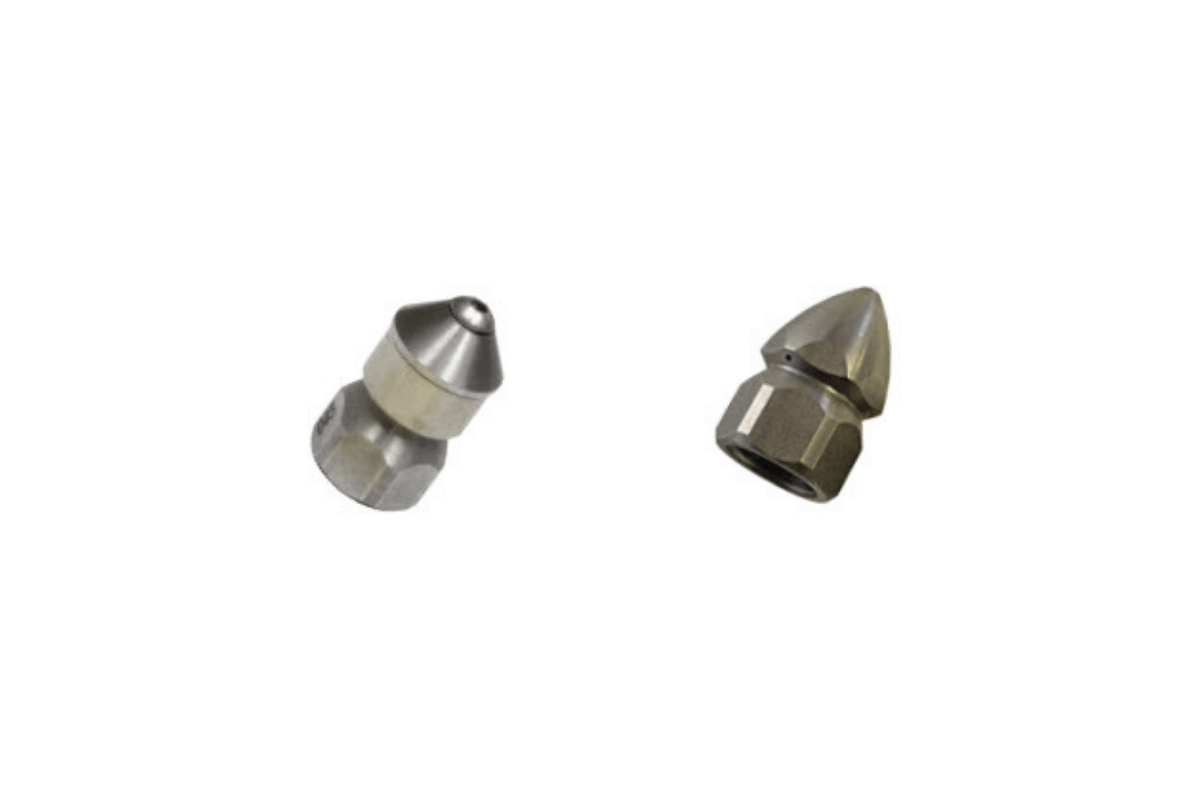
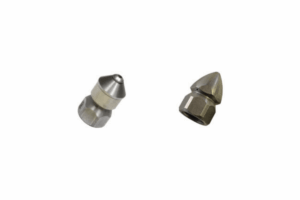
A fan nozzle cleans in a line. A turbo nozzle spins a zero-degree jet in a cone, so you get the cutting force of a pencil jet across the coverage of a fan. On bonded material, that is a different tool, not a better version of the same one.
Size it by orifice, not by name
This is the part that gets skipped. The number in the part name is the orifice size, and it has to match your pump’s flow at your pressure. Too small and you overpressure the system; too large and pressure never builds.
The UR line also includes higher-rated heads, the UR60 07 and the UR50 07. Their published pressure ratings are being confirmed with AR at the moment, so ask us for the current figure before you size a system around either one rather than working from the listing.
For ultra high pressure work the TPR400-08 is rated 5,800 PSI on a 1/2 in FNPT connection. On quick-connect rigs, SD47053 and SD47050 plug straight in.
Where they earn their place
Coating and epoxy removal. Concentrated impact lifts layers that a fan tip only polishes. This is the job turbo nozzles exist for.
Paint preparation. Stripping failed paint and surface contamination back to sound substrate before recoating.
Gum removal. The rotating jet breaks the adhesive bond in a way a fan pattern does not, which is why municipal crews carry them.
Heavy concrete cleaning. Embedded dirt, algae and tyre marks on concrete and masonry.
And where they do not
Worth being clear about, because the aggression is the point and it cuts both ways.
A turbo nozzle is a zero-degree jet. It will etch concrete, cut wood, strip paint you meant to keep, damage mortar and destroy vinyl siding, and it does all of that faster than you can react.
Never on siding, painted surfaces or soft wood unless removal is the goal
Keep it moving. A stationary turbo nozzle leaves a visible ring within seconds
Test on an inconspicuous area first, every time, on any surface you have not done before
Watch the standoff distance. Impact falls off quickly, so distance is your main control
For broad flat work, a surface cleaner gives you even coverage without the risk of striping. Turbo nozzles are for spots and edges.
Turbo nozzle maintenance
The rotating mechanism is the wear point. If it slows or stops spinning, the tool becomes a stationary zero-degree jet, which is how surfaces get damaged unintentionally.
Flush after every use, especially after chemical
Check that it spins freely before each job
Replace when rotation becomes inconsistent, not when it stops
Never drop one. The internal bearing does not survive it.
The Honda GX200 is a small engine, and the mistake people make with Honda GX200 pump packages is buying a
Manage Consent
To provide the best experiences, we use technologies like cookies to store and/or access device information. Consenting to these technologies will allow us to process data such as browsing behavior or unique IDs on this site. Not consenting or withdrawing consent, may adversely affect certain features and functions.
Functional
Always active
The technical storage or access is strictly necessary for the legitimate purpose of enabling the use of a specific service explicitly requested by the subscriber or user, or for the sole purpose of carrying out the transmission of a communication over an electronic communications network.
Preferences
The technical storage or access is necessary for the legitimate purpose of storing preferences that are not requested by the subscriber or user.
Statistics
The technical storage or access that is used exclusively for statistical purposes.The technical storage or access that is used exclusively for anonymous statistical purposes. Without a subpoena, voluntary compliance on the part of your Internet Service Provider, or additional records from a third party, information stored or retrieved for this purpose alone cannot usually be used to identify you.
Marketing
The technical storage or access is required to create user profiles to send advertising, or to track the user on a website or across several websites for similar marketing purposes.