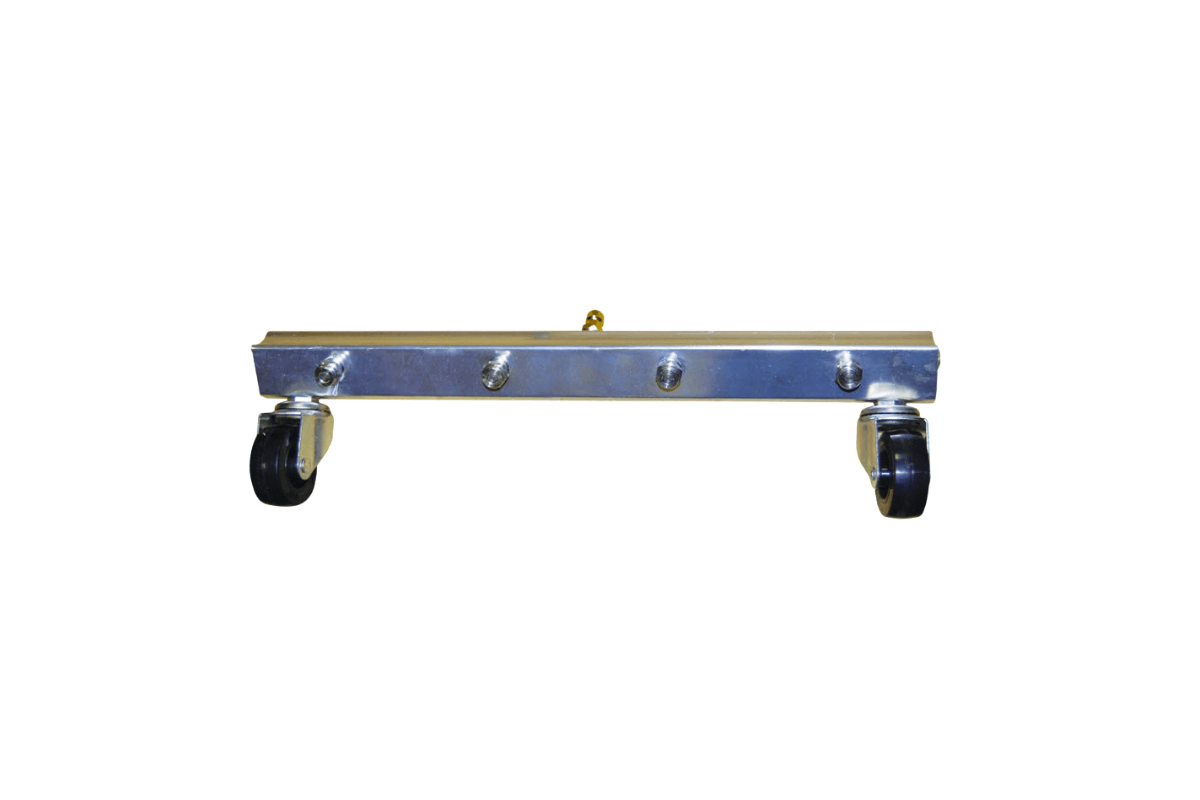
Cleaning a driveway with a wand takes about four times as long as it should and leaves stripes you will see from the road. A compact surface cleaner puts two or three spinning jets under a shroud, covers a fixed width per pass, and gives you an even finish because the spray pattern never changes angle.
Two compact models cover most of the work below 20 inches. They are not interchangeable, and the difference is not size.
Look at flow, not width. The AR-ROTARY14 handles up to 8.0 GPM. The MLSC15 is built for a much smaller machine, and its flow rating is not published, so ask us before pairing it with a contractor pump. That gap is the reason these two tools belong on different machines.
Run a surface cleaner below its designed flow and the head turns slowly, coverage per pass drops, and you end up going over the same concrete twice. Run one above its rating and you overpressure the swivel. So the honest first question is what your pump actually puts out.
Pump makes 2 to 3 GPM: the MLSC15 is your tool. The AR-ROTARY14 will work but it will not spin the way it is meant to.
Pump makes 4 GPM or more: the AR-ROTARY14, comfortably.
Running hot water: temperature ratings are not published for either of these, so ask us to confirm before you run hot water through one.
MLSC15
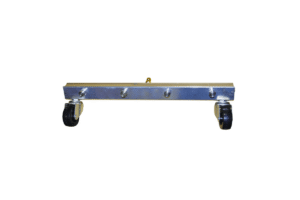
Fifteen inches, three nozzles, 3,200 PSI, cold water. This is the homeowner and light contractor tool: patios, pool decks, driveways, sidewalks, and deck or fence prep before paint. It is light enough to carry one-handed and to work vertically on a wall if you need to, which the heavier stainless models are not.
The three-nozzle head is a real advantage at low flow. Splitting a small flow three ways gives a more even pattern than splitting it two ways at the same pressure.
AR-ROTARY14
Fourteen inches, two nozzles, 4,000 PSI, 8 GPM. Slightly narrower than the MLSC15 but a substantially more capable tool, because it can take everything a serious contractor rig puts out.
The flow rating is what earns its keep. At 8 GPM it keeps up with a full contractor rig, which is why this is the one that goes to restaurant entryways, garage floors and fleet yards. If you plan to run hot water through it, ask us to confirm the rating first.
If you need more width on the same kind of rig, the AR-ROTARY20 and the stainless AR-ROTARY20SS and AR-ROTARY24SS cover 20 and 24 inches at the same 4,000 PSI.
Getting your money out of one
Flush after every use. Debris dries in the nozzle orifices and the head goes out of balance.
Check the nozzles for wear. A worn orifice passes more water at lower pressure, so cleaning gets slower and nobody can say why. This is the first thing to check when a surface cleaner stops performing.
Keep the skirt in contact with the surface. The shroud is what contains the spray and holds the working distance; lifting it wastes pressure and soaks you.
Do not drop it. The housing takes the impact and a cracked shroud never seals the same way again.
Store it dry and out of sun.
Where compact surface cleaners are used
Residential: driveways, sidewalks, pool decks, patios, pavers, deck and fence prep. Light commercial: storefronts, restaurant entryways, garage and workshop floors, tire marks and oil spots. Tighter jobs: fleet yards where you need to work between vehicles, municipal sidewalks and bus stops, barn walkways and farm surfaces.
The Honda GX200 is a small engine, and the mistake people make with Honda GX200 pump packages is buying a
Manage Consent
To provide the best experiences, we use technologies like cookies to store and/or access device information. Consenting to these technologies will allow us to process data such as browsing behavior or unique IDs on this site. Not consenting or withdrawing consent, may adversely affect certain features and functions.
Functional
Always active
The technical storage or access is strictly necessary for the legitimate purpose of enabling the use of a specific service explicitly requested by the subscriber or user, or for the sole purpose of carrying out the transmission of a communication over an electronic communications network.
Preferences
The technical storage or access is necessary for the legitimate purpose of storing preferences that are not requested by the subscriber or user.
Statistics
The technical storage or access that is used exclusively for statistical purposes.The technical storage or access that is used exclusively for anonymous statistical purposes. Without a subpoena, voluntary compliance on the part of your Internet Service Provider, or additional records from a third party, information stored or retrieved for this purpose alone cannot usually be used to identify you.
Marketing
The technical storage or access is required to create user profiles to send advertising, or to track the user on a website or across several websites for similar marketing purposes.