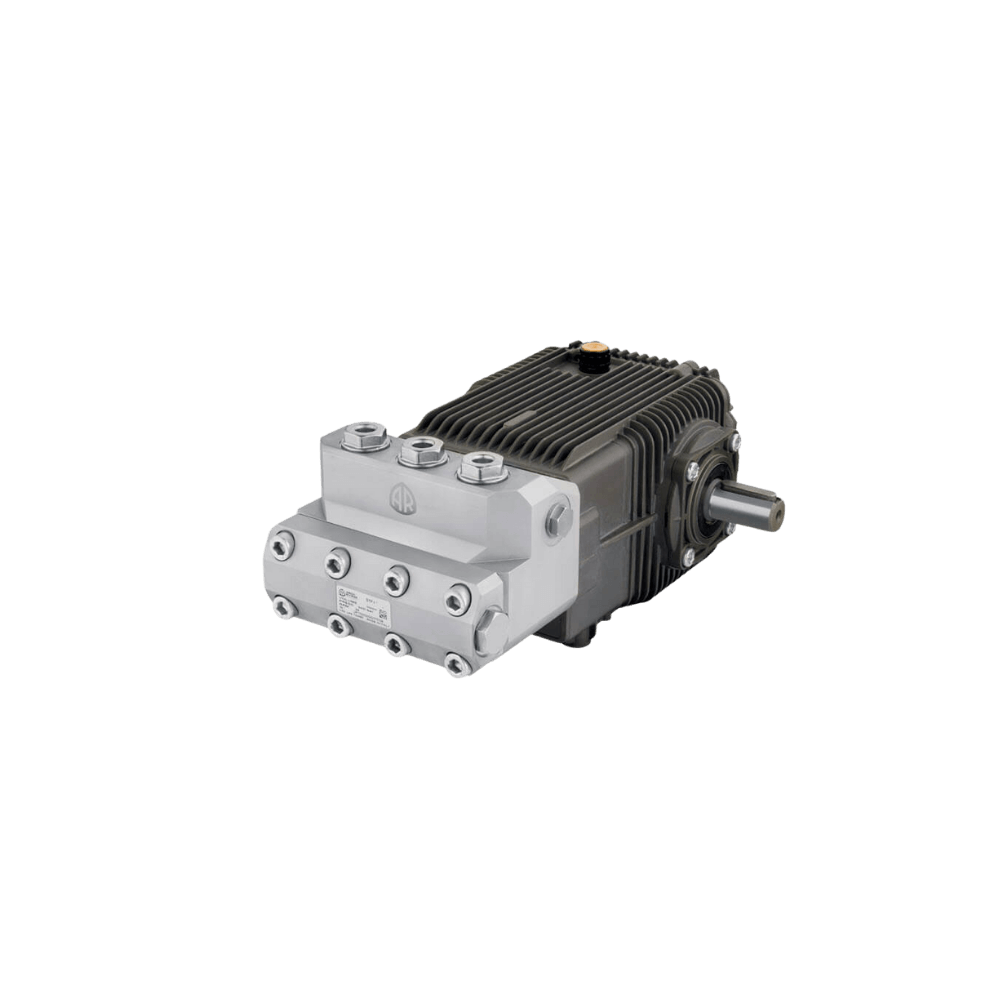
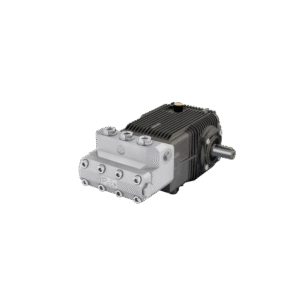
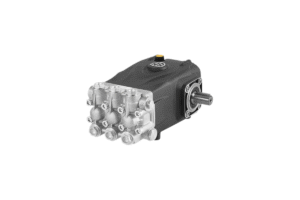
Look at the EBHP column. Every model in the range needs roughly the same power, between 20 and 22 HP. The series is designed that way: one motor size, and you choose where on the flow-versus-pressure curve you want to sit.
The HN suffix on the XWP70.12HN is a nickel-plated head, for hard water, detergent and anywhere plain brass will pit.
Choosing along the curve
13.2 GPM at 2,200 PSI: the most pressure in the range. Right when there is baked-on soil and you still need volume.
15.9 GPM at 1,900 PSI: the middle. A good general washdown choice.
18.5 GPM at 1,740 PSI: maximum coverage. Right for sanitation rinse, multiple stations and large surface cleaners, where 1,740 PSI is more than enough and the volume is the point.
If you are rinsing rather than removing, go to the higher flow. If you are removing, go to the higher pressure, or look at a different family.
What the supply has to look like
This is the constraint that catches people. An 18.5 GPM pump needs 18.5 GPM delivered continuously at positive inlet pressure. That means a tank above the pump and a properly sized feed line, not a hose, not a long run of 3/4 in pipe, and not a restrictive gate valve.
Starve an XWP and it cavitates. The noise is unmistakable and the damage is not reversible.
How XWP pumps are built
Brass head, stainless valves, ceramic plungers
Oversized bearings and heavy-duty crankcase
31.8 oz oil capacity, doing most of the cooling at this load
24 mm solid shaft, for belt drive or direct motor coupling
1,450 RPM, which is why these last
Where XWP pumps are used
Municipal: storm drain cleaning, street and infrastructure washdown
Agriculture: irrigation line flushing, greenhouse sanitation, livestock facilities
Food processing: high-flow equipment and workspace sanitation
Fleet and heavy equipment: truck, bus and construction vehicle wash stations
Mining and industrial: equipment washdown and dust suppression
Marine: hull cleaning, pier maintenance, high-volume wash systems
Energy and utilities: cooling tower cleaning, industrial scale flushing
The common thread is a lot of surface and a lot of water, on a schedule.
Servicing XWP pumps
Fully rebuildable, with valve kits, piston kits, water seals, oil seals and hot water seal sets available, plus rail kits in 1-1/4 in, 2-1/2 in and U-bracket for mounting. Confirm part numbers against your exact model, because the HN variant differs.
On a pump running eight hours a day, the maintenance schedule is the whole difference. Oil on interval, seals replaced before they fail, inlet filtered and the filter cleaned. Done properly these run for thousands of hours; done poorly they are an annual rebuild.
The Honda GX200 is a small engine, and the mistake people make with Honda GX200 pump packages is buying a
Manage Consent
To provide the best experiences, we use technologies like cookies to store and/or access device information. Consenting to these technologies will allow us to process data such as browsing behavior or unique IDs on this site. Not consenting or withdrawing consent, may adversely affect certain features and functions.
Functional
Always active
The technical storage or access is strictly necessary for the legitimate purpose of enabling the use of a specific service explicitly requested by the subscriber or user, or for the sole purpose of carrying out the transmission of a communication over an electronic communications network.
Preferences
The technical storage or access is necessary for the legitimate purpose of storing preferences that are not requested by the subscriber or user.
Statistics
The technical storage or access that is used exclusively for statistical purposes.The technical storage or access that is used exclusively for anonymous statistical purposes. Without a subpoena, voluntary compliance on the part of your Internet Service Provider, or additional records from a third party, information stored or retrieved for this purpose alone cannot usually be used to identify you.
Marketing
The technical storage or access is required to create user profiles to send advertising, or to track the user on a website or across several websites for similar marketing purposes.