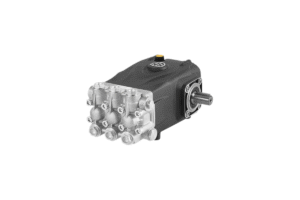
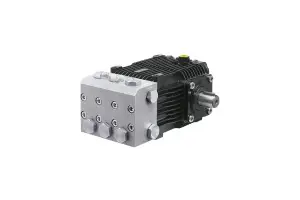
Industrial does not mean bigger. AR industrial pumps are expected to run continuously at a specification that would destroy a contractor pump in a season, and it means the drive, the water supply and the electrical service all have to be designed around it rather than assumed.
The AR industrial range spans 4 to 40 GPM and 1,450 to 11,600 PSI. Here is how it divides up, because the series letters do not tell you.
Pressure or volume, not both
The most useful way to read the range is by which half of the trade each family takes.
Read that table once and the whole range makes sense. RTF and XWP move water. SHP, SHPA and RTP cut. RF and RTJ sit in the middle with useful amounts of both. RTX and RTD are the hydraulic-drive families spanning the range.
Start from the motor, not the pump
At industrial scale the drive is the real constraint. EBHP is GPM times PSI divided by 1,460, and the numbers get serious fast:
10.3 GPM at 5,800 PSI needs 41 HP at the shaft
13.2 GPM at 2,200 PSI needs 20
4 GPM at 7,250 PSI needs 20
44 GPM at 1,500 PSI needs 45
Add margin and you are specifying 25 to 50 HP motors, three-phase service, and a panel to match. That decision usually constrains the pump more than the cleaning requirement does, so settle it first.
And from the water
A 40 GPM pump needs 40 GPM delivered, continuously, at positive inlet pressure. That is a tank and a properly sized feed line, not a hose. Starving an industrial pump produces cavitation, and cavitation at this scale is a rebuild rather than a noise.
What AR industrial pumps share in construction
Solid shaft, 24 to 35 mm, for pulley drive or direct coupling
Brass or nickel-plated brass manifolds
Ceramic plungers, which is what survives the abrasion at these pressures
Stainless valves
Oversized crankcases, from 32 oz up to 1.07 gallons, because the oil carries the heat
Low speed, 1,000 or 1,450 RPM, which is most of why these last
Where AR industrial pumps are used
Concrete hydro-demolition: removing concrete with water instead of jackhammers, which leaves rebar intact
Steel surface prep before coatings, in marine and shipyard work
Mining and heavy industry: equipment and structure washing
Food and beverage: sanitary processing and washdown systems
Energy: power plant maintenance, heat exchanger cleaning, descaling
Oil and gas: pipeline cleaning, rig maintenance, offshore washing
Specialty contracting: graffiti removal, paint stripping, tank cleaning
The case for buying one
These are fully rebuildable, with rail kits, seal kits, valve kits, piston kits and oil available for every family. At this price point that is not a convenience, it is the entire economic argument: a rebuild is a fraction of a replacement, and a maintained industrial pump runs for thousands of hours.
There is also a directional argument for water-based surface prep. As regulation on abrasive blasting tightens, hydro-demolition and water prep pick up work that used to go to abrasives, and the equipment to do it is this range.
The Honda GX200 is a small engine, and the mistake people make with Honda GX200 pump packages is buying a
Manage Consent
To provide the best experiences, we use technologies like cookies to store and/or access device information. Consenting to these technologies will allow us to process data such as browsing behavior or unique IDs on this site. Not consenting or withdrawing consent, may adversely affect certain features and functions.
Functional
Always active
The technical storage or access is strictly necessary for the legitimate purpose of enabling the use of a specific service explicitly requested by the subscriber or user, or for the sole purpose of carrying out the transmission of a communication over an electronic communications network.
Preferences
The technical storage or access is necessary for the legitimate purpose of storing preferences that are not requested by the subscriber or user.
Statistics
The technical storage or access that is used exclusively for statistical purposes.The technical storage or access that is used exclusively for anonymous statistical purposes. Without a subpoena, voluntary compliance on the part of your Internet Service Provider, or additional records from a third party, information stored or retrieved for this purpose alone cannot usually be used to identify you.
Marketing
The technical storage or access is required to create user profiles to send advertising, or to track the user on a website or across several websites for similar marketing purposes.