A brass pump head in a food plant has a shelf life, which is why an XWLA-SS stainless pump is specified instead. Caustics, chlorinated sanitizers and hot rinse water attack brass continuously, and what you see first is not a failure but a slow loss of pressure as the valve seats pit. Then the seals go. Then you are rebuilding the same pump every few months.
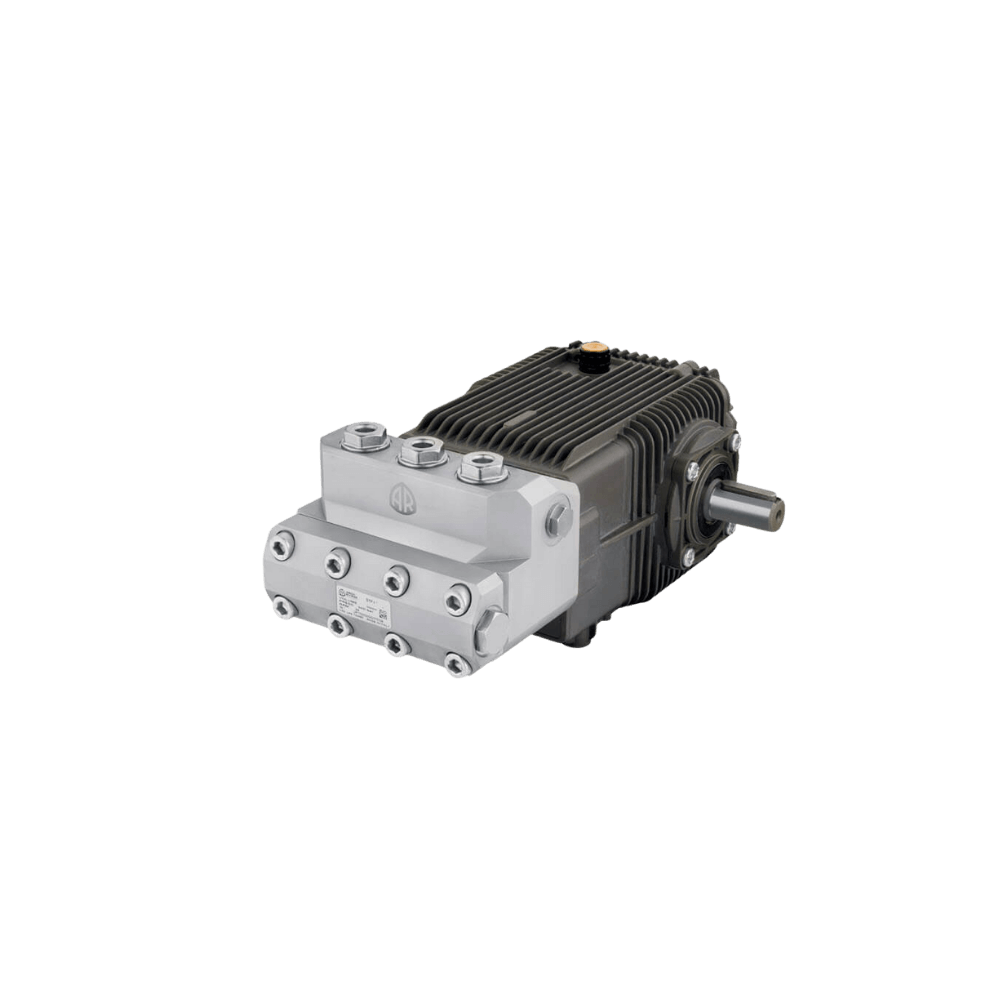
The XWLA-SS puts a stainless head and Viton sealing on a high-flow 1750 RPM triplex, which is the combination that survives that environment.
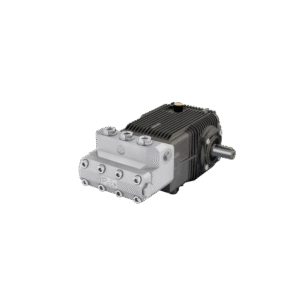
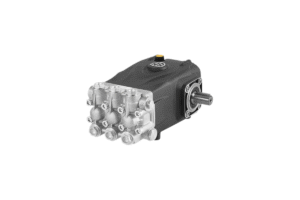
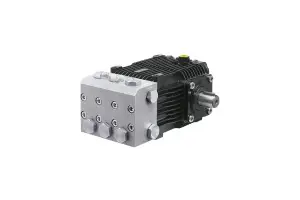
The two XWLA-SS stainless pumps
| Model | Flow | Pressure | EBHP | Motor | Best for |
|---|---|---|---|---|---|
| XWLASS8G35N | 8 GPM | 3,500 PSI | 19.2 | 25 HP | Heavier soil, more pressure per nozzle |
| XWLASS12G22N | 12 GPM | 2,200 PSI | 18.1 | 25 HP | Wide-area rinse, multiple stations |
Both run at 1,750 RPM on a 24 mm solid shaft and both need roughly the same motor. The choice is purely how you want that power spent: 12 GPM covers more surface per minute, 8 GPM at 3,500 PSI hits harder at the nozzle. For sanitation rinse, volume usually wins. For baked-on process residue, pressure does.
XWLASS12G22N specifications
- Flow and pressure: 12 GPM at 2,200 PSI
- EBHP: 18.1, so a 25 HP motor with proper margin
- Bore and stroke: 36 mm x 28 mm
- Speed: 1,750 RPM
- Oil capacity: 15 oz
- Weight: 45 lbs
- Shaft: 24 mm solid
What the materials are doing
- 316L stainless head. The 316 grade adds molybdenum, which is what buys the chloride resistance. That is the difference that matters around salt and sanitizers, not stainless in general.
- Viton O-rings and water seals. Viton holds its properties at temperature and against oils and aggressive detergents where nitrile hardens and cracks.
- Bronze connecting rods. Stronger than aluminium under sustained load and heat.
- 15 oz crankcase. At 1,750 RPM on continuous duty the oil is doing the cooling, and capacity is what keeps its temperature down.
When stainless is not the answer
Stainless costs more, and on clean municipal water it buys nothing a brass head does not already give you. If your water and your chemistry are ordinary, the standard XWLA13G15N at 13 GPM / 1,500 PSI or XWLA11G30NB at 11.1 GPM / 3,000 PSI does the same work for less.
Go stainless when the water contains salt or chlorides, when you run caustic or acid sanitizers, when you are washing with solvents, or when the pump lives in salt air. In those four cases the price difference is recovered in the first rebuild you do not have to do.
Where XWLA-SS stainless pumps are used
- Food and beverage: equipment, conveyor and floor washdown, USDA-compliant stations in meatpacking, dairy parlors, bottling lines
- Marine and offshore: deck and dock washdown, fishing vessels, platform equipment, shipyard hull work
- Pharmaceutical: sterile processing equipment cleaning and solvent-resistant wash systems
- Chemical processing: wash skids and neutralization stations running caustic or solvent cycles
- Heavy industrial: mining, oil and gas, and wastewater washdown on continuous duty
Making an XWLA-SS pump last
- Filter the inlet. Stainless resists chemistry, not abrasion. Grit will score a 316L seat exactly as fast as a brass one.
- Watch the oil. 15 oz, checked at the sight glass before each shift. Milky means water past the seals.
- Replace Viton seals on schedule, not on failure. They last a long time and then fail quickly.
- Use stainless hardware at the fittings. Bolting a plated steel fitting to a stainless head sets up galvanic corrosion and undoes the point of the pump.
- Flush with clean water after every chemical or saltwater run. This is the single habit that separates pumps that last from pumps that do not.
Service kits are model specific. Confirm the kit against your exact MPN rather than against the series, because plunger diameter changes across the stainless range and the wrong kit will not seat.
Browse the full stainless steel pump range, or tell me what is in your water and you will get a straight answer on whether stainless is worth it for your operation.