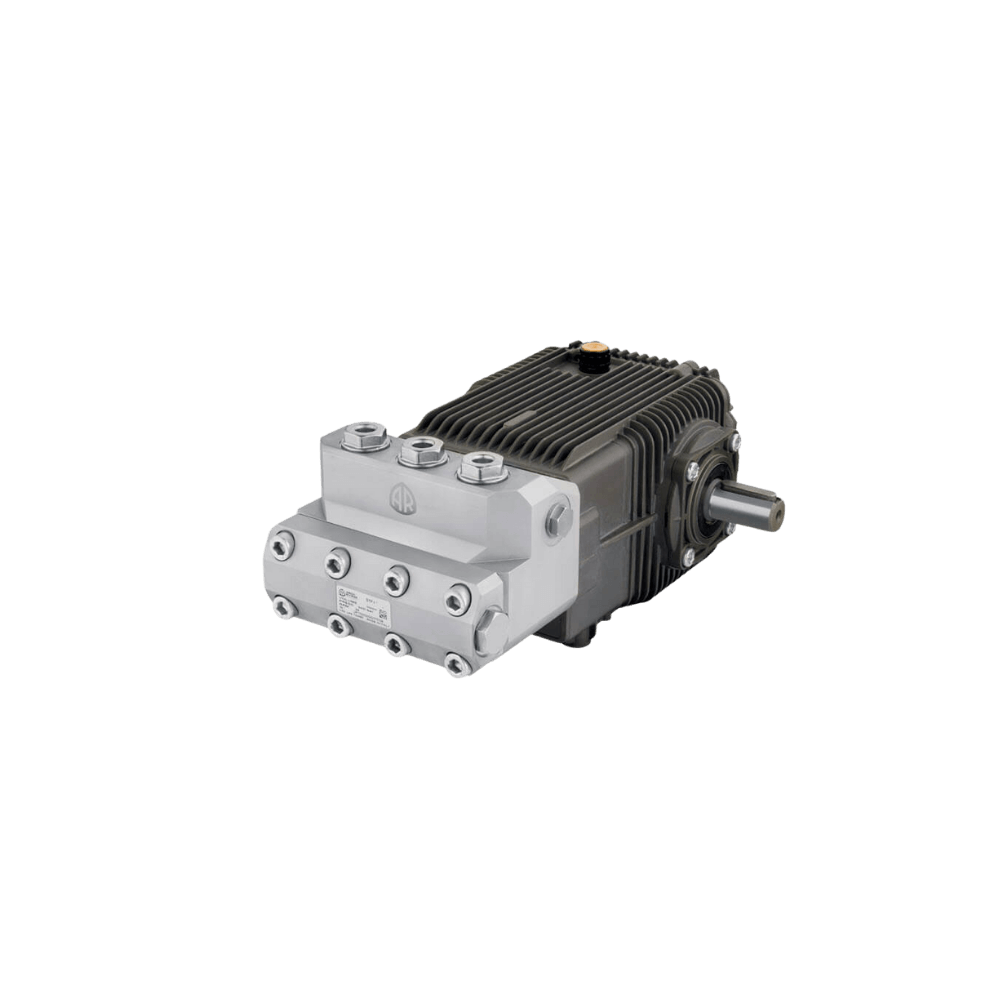
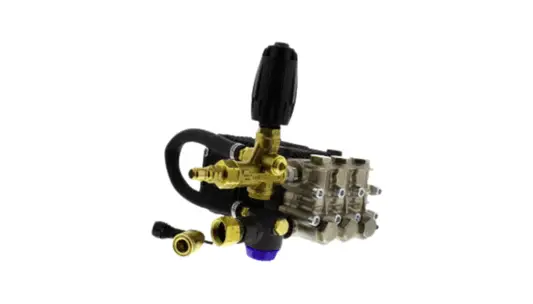
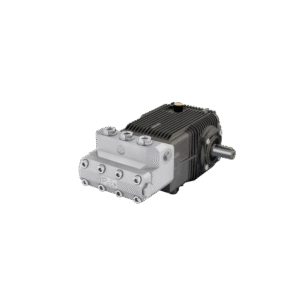
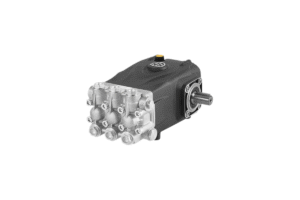
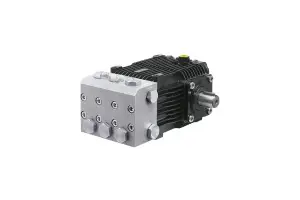
The RTX is the top of AR’s industrial range, and it comes two ways. You can buy the pump alone and drive it yourself, or you can buy an RTX hydraulic drive pump already coupled to a Sauer Danfoss hydraulic motor. The decision depends on whether you are building a system or installing one.
Either way the range covers 8 to 39.6 GPM and 1,450 to 4,350 PSI, all at 1,450 RPM.
There are also WC variants (HYD-RTX30WC, HYD-RTX70WC) and the HYDM-DF-044 44cc Danfoss motor if you are building the pairing yourself.
Sizing the drive properly
EBHP is GPM times PSI divided by 1,460, and at RTX pressures the numbers are large. The RTX60-DD needs 47 HP at the shaft. The RTX85-DD needs 46. The RTX150 needs 39 even at only 1,450 PSI, because 39.6 GPM is a lot of water.
Whatever drives the pump, motor, engine or hydraulic circuit, has to deliver that with margin. On the hydraulic packages, check your circuit’s available flow and pressure at working temperature rather than the machine’s brochure figure. A hydraulic system that made its rated flow when new may not now, and a starved motor turns the pump slowly, which looks like a bad pump and is not.
How RTX hydraulic drive pumps are built
Head: nickel-plated brass, for aggressive water
Connecting rods: aluminium
Plungers and valves: stainless
Crankcase: 76 oz oil capacity
Speed: 1,450 RPM
Ports: 1 in F inlet, 1/2 in F discharge
The 1,450 RPM and the 76 oz crankcase go together. At this size the oil is doing most of the cooling, and running slowly is what keeps a pump this loaded alive for years rather than seasons.
Which RTX hydraulic drive pump configuration to choose
Buy the direct drive pump if you are an OEM or a skid builder, you already have a motor or gearbox specified, and you want to control the coupling and the layout. You take on the alignment, and alignment is what kills hydraulic installations done by eye.
Buy the hydraulic motor package if you are fitting a pump to an existing machine that already carries hydraulics. The pairing is done, the alignment is done, and you are plumbing rather than engineering.
Where RTX hydraulic drive pumps are used
Oil and gas: drilling rigs, offshore platforms, washdown skids
Mining and quarrying: dust suppression, conveyor cleaning, equipment wash bays
Municipal: sewer jetting, wastewater treatment, street cleaning
Fleet and rail: train wash stations, truck depots, transit
Industrial plants: descaling, process washdown, food plant sanitation
Marine: dockside cleaning and hull maintenance
Servicing RTX hydraulic drive pumps
Keep the crankcase topped with non-detergent SAE30. At 76 oz, check it rather than assuming.
On hydraulic installations, watch circuit temperature. Overheating shows up in the hydraulics before it shows up in the pump.
Replace seals and valves on an hours interval using AR rebuild kits, not after a failure.
Re-torque mounting bolts after the first run hours, then periodically. Vibration and misalignment are the same problem seen twice.
Filter the supply water. At these flows, unfiltered water moves a lot of grit through the valves.
The Honda GX200 is a small engine, and the mistake people make with Honda GX200 pump packages is buying a
Manage Consent
To provide the best experiences, we use technologies like cookies to store and/or access device information. Consenting to these technologies will allow us to process data such as browsing behavior or unique IDs on this site. Not consenting or withdrawing consent, may adversely affect certain features and functions.
Functional
Always active
The technical storage or access is strictly necessary for the legitimate purpose of enabling the use of a specific service explicitly requested by the subscriber or user, or for the sole purpose of carrying out the transmission of a communication over an electronic communications network.
Preferences
The technical storage or access is necessary for the legitimate purpose of storing preferences that are not requested by the subscriber or user.
Statistics
The technical storage or access that is used exclusively for statistical purposes.The technical storage or access that is used exclusively for anonymous statistical purposes. Without a subpoena, voluntary compliance on the part of your Internet Service Provider, or additional records from a third party, information stored or retrieved for this purpose alone cannot usually be used to identify you.
Marketing
The technical storage or access is required to create user profiles to send advertising, or to track the user on a website or across several websites for similar marketing purposes.