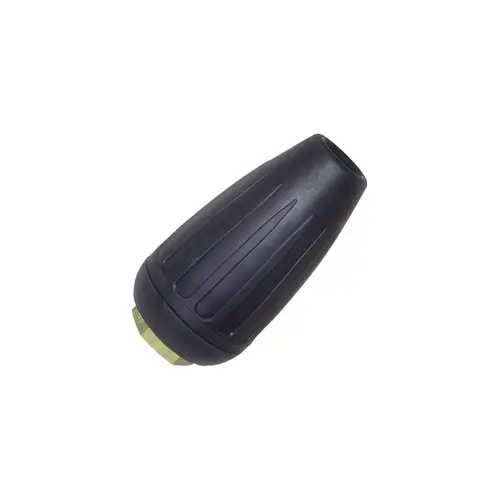
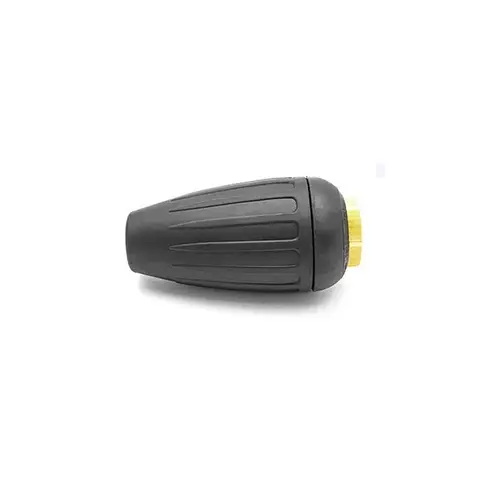
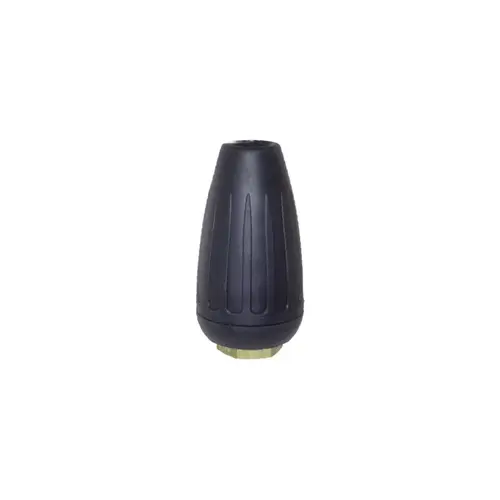
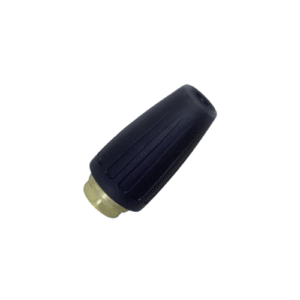
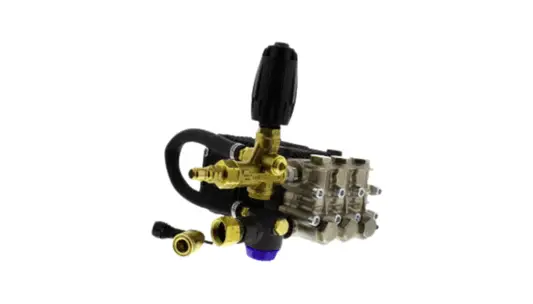
ROTOJET400-12 turbo nozzle, size 12 orifice at 5,800 PSI
The ROTOJET400-12 is a rebuildable turbo nozzle from the TEV-Jager RotoJet 400 range, rated to 5,800 PSI on a 1/4 in. female inlet. It spins a concentrated 0° jet into a cone, so you get the impact of a zero-degree tip with the coverage of a fan. On hardened coatings, rust and industrial grime that is the difference between a pass that works and a pass that polishes the dirt.
Size 12 sits toward the high-flow end of the RotoJet 400 range, which runs from 020 up to 20. It wants a machine with the flow to feed it. On a pump that cannot supply it you will lose pressure at the tip and the rotor will slow, which looks like a faulty nozzle and is not.
Performance specifications
- Maximum pressure: 5,800 PSI
- Orifice size: 12
- Inlet: 1/4 in. female, threaded
- Spray action: rotating 0° jet in a cone pattern
- Brand: TEV-Jager, Germany
Build & Materials (Made to Last)
- Brass body with a precision ceramic orifice and race, under a protective outer shell
- Rebuildable, so wear parts are replaced rather than the whole nozzle
- Precision-balanced rotor, which is what keeps rotation smooth under load instead of chattering
- Seals and bearings rated for continuous high-pressure duty
What the ROTOJET400-12 is for
The rebuildable construction is the argument for this nozzle over a throwaway turbo tip. A sealed turbo nozzle is scrap once the ceramic wears; this one takes a service kit. If you are running one machine occasionally that does not matter much. If you are running a crew daily, it is most of the cost difference.
- Concrete, masonry and structural steel preparation
- Coating and corrosion removal on industrial plant
- Shipyard and marine surface cleaning
- Municipal work on sidewalks, bridges and parking structures
- Rental yard and heavy equipment washing
Matching it to your machine
The orifice has to match your pump’s flow, and this is where most turbo nozzles get bought wrong. Too small and you build pressure the pump was not sized for; too large, which is the usual mistake at this end of the range, and you lose pressure at the tip and the rotor slows. Check your pump’s rated GPM against the orifice before ordering, and re-check whenever you change pumps, unloaders or hose length.
Your system also needs to be rated at or above 5,800 PSI throughout, including the hose, the lance and the couplings. The nozzle is not the weakest link unless everything upstream is stronger than it.
Setup, use and maintenance
- Commissioning: confirm pump output matches the orifice and that the whole system is rated to 5,800 PSI
- Operation: purge air, then work in overlapping passes, keeping the nozzle moving to avoid gouging
- Water: feed it filtered or screened water. Grit is what kills the ceramic
- After chemicals: flush the nozzle before storing it
- Service: inspect the rotor and seals when rotation slows or the pattern goes uneven, and fit a service kit rather than replacing the nozzle
- Safety: never spray people, animals, glass or decals, and wear PPE rated for the pressure you are running


Reviews
There are no reviews yet.