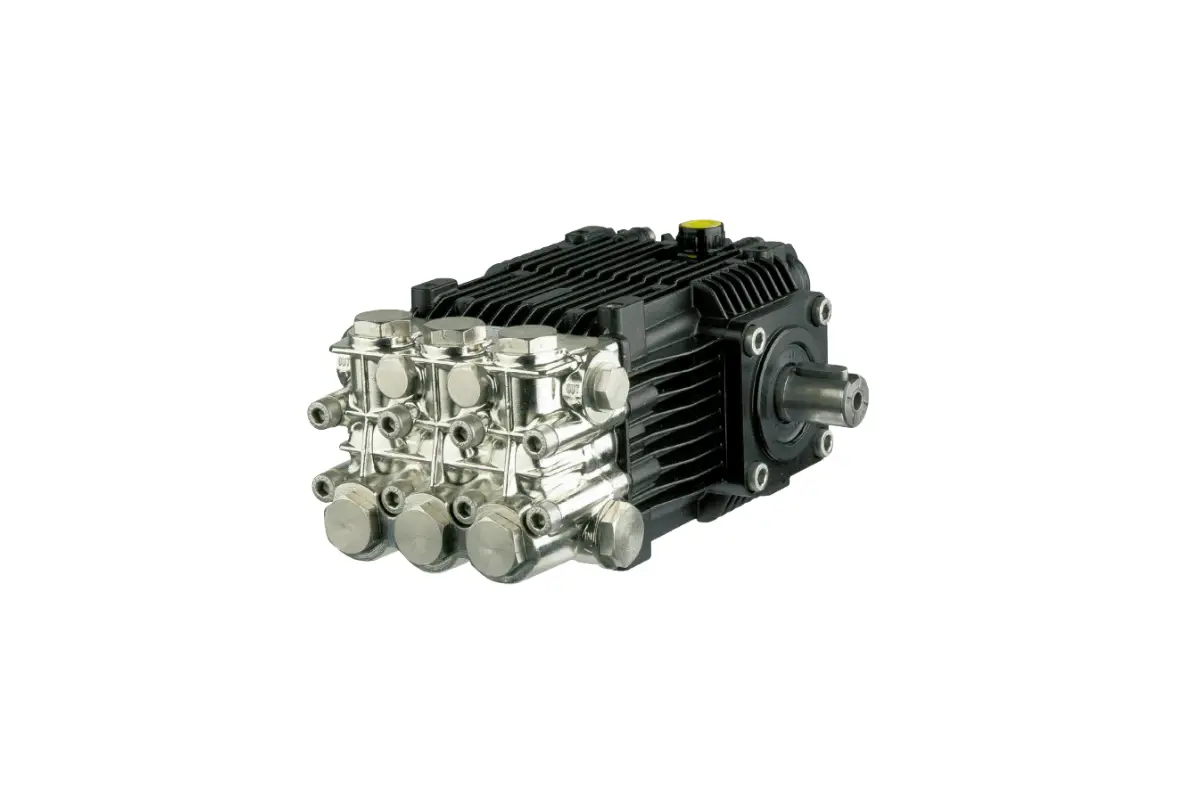
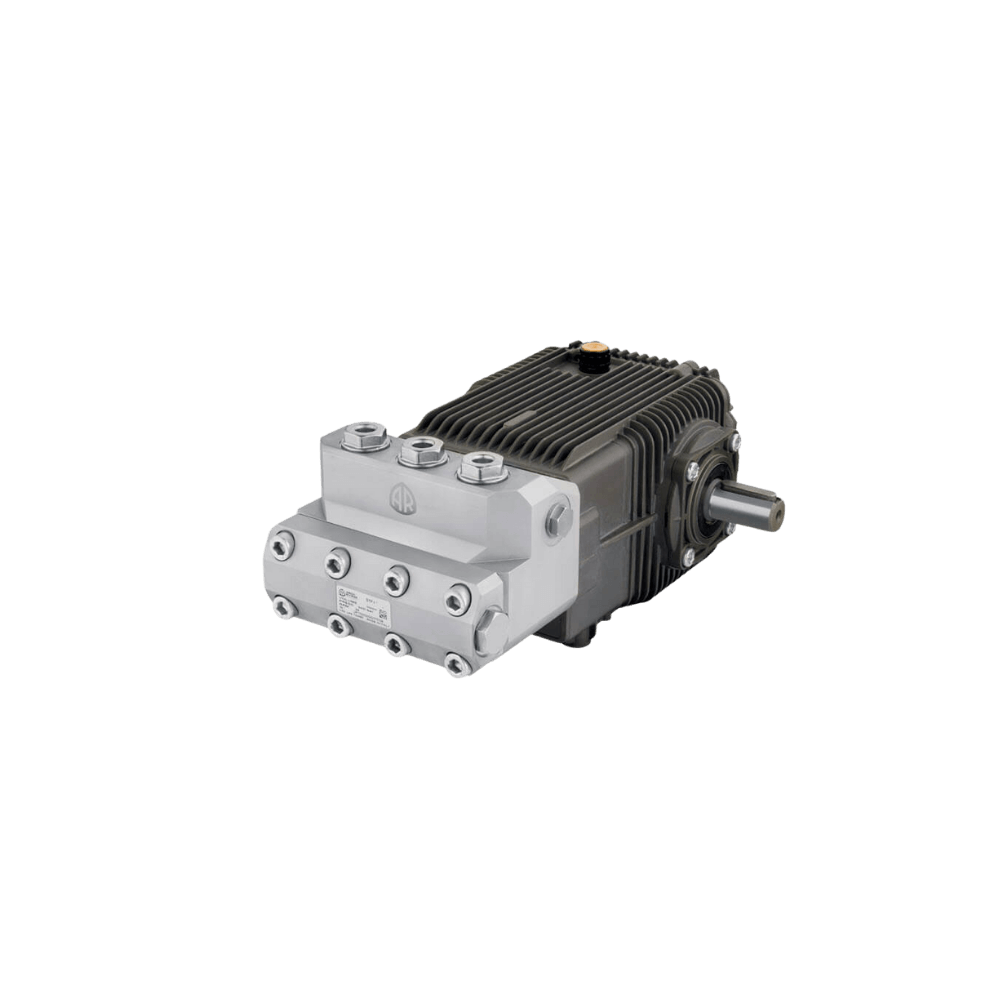
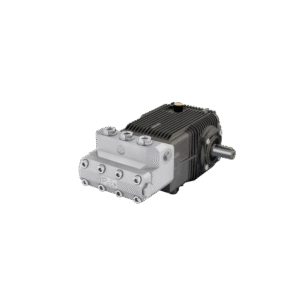
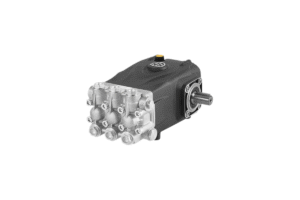
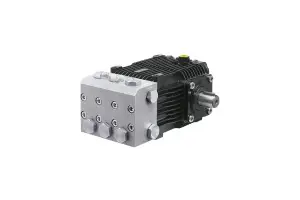
The RKW1514N turns at 950 RPM. That is the whole point of it, and it is why the pump looks unimpressive on a spec sheet next to something spinning at 3,400.
At 4.0 GPM and 2,000 PSI it will not out-clean a contractor rig. What it will do is run for years in an installation where nobody wants to think about the pump: a specialty wash tunnel, a CIP rinse loop, a reclaim system, an ag sprayer that runs all season.
Why low RPM matters
Every wear interface in a triplex pump, plunger seals, crank pins, bearings, valve seats, wears as a function of cycles and heat. Halving the speed roughly halves the cycle count per hour and drops the friction heat with it.
There is a second benefit people notice before they notice the first. Lower speed means gentler pulsation, which means a steadier gauge, a better-behaved unloader, and a gun that does not buck. On systems where finish quality matters, that stability is worth more than peak pressure.
The tradeoff is that you need gear reduction. A 1,750 RPM motor cannot drive this pump directly.
RKW1514N specifications
- Output: 4.0 GPM at 2,000 PSI (15 L/min at 140 bar)
- Speed: 950 RPM
- Shaft: 24 mm solid shaft, N version
- Head: nickel-plated brass
- Internals: bronze connecting rods, oversized crankshaft bearings
- Oil capacity: 13.35 oz
- Ports: 1/2 in F inlet, 3/8 in F discharge
- Seals: Viton water seals available for chemical duty
The nickel-plated head is the part that justifies the price in reclaim water. Bare brass pits and scales when it sees hard water and detergent day after day; plating buys you real time before that starts.
RKW1514N power and drive
EBHP is 4.0 x 2,000 / 1,460, or about 5.5 HP. Size the motor 15 to 20 percent above that for heat, altitude and line losses, which puts you on a 7.5 HP frame.
Torque is the number people forget at low RPM. HP = torque x RPM / 5,252, so 5.5 HP at 950 RPM is about 30 ft-lb, roughly 41 N·m. Your coupling, key and shaft have to carry that, and a coupling sized by horsepower alone will be undersized here.
RKW1514N pulley ratio
From a 1,750 RPM motor the ratio is 950 / 1,750, or 0.543. A 3.0 in motor sheave pairs with a 5.53 in pump sheave, so a 5.5 in standard sheave lands you at 955 RPM, close enough. Check guard clearance, pick an A or B section belt for the horsepower, and leave enough center distance to actually tension it.
Setting it up once, properly
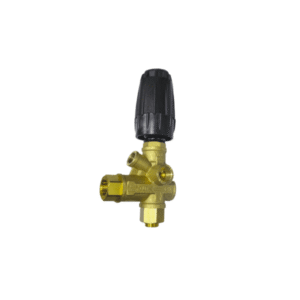
- Thermal relief. If the system spends real time in bypass, fit a thermal relief valve. At 950 RPM heat builds slower, but it still builds.
- Inlet plumbing. Short, straight, full-flow valves, 1/2 in equivalent or larger. Inlet restriction is the number one cause of cavitation, and cavitation is what destroys valve seats.
- Filtration. Oversize the in-line filter, especially on reclaim water. Cheapest part on the rig, biggest effect.
- Nozzle. Orifice size sets pressure, not the pump. If pressure drifts down over months, the nozzle has worn larger. Replace it before you start adjusting the unloader.
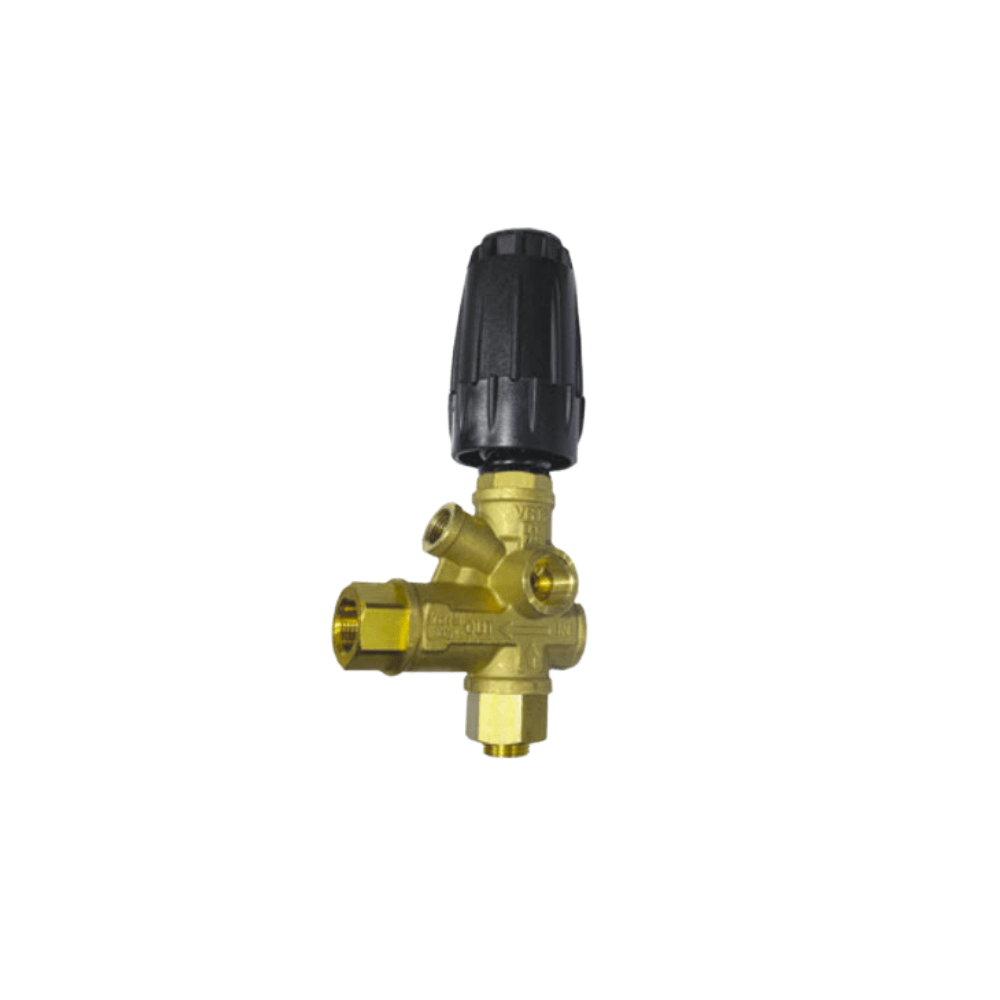
- Unloader. Set it with the trigger open, confirm the bypass behavior, then lock the jam nut.
- Bypass routing. Return to tank on hot water or high ambient. Never back into the inlet.
- Instrumentation. A glycerin-filled gauge at the head tells you about valve wear months before anything fails.
RKW1514N maintenance
First oil change at about 50 hours, then on AR’s schedule. Milky oil means water past the seals. Weeping at a joint under pressure means an O-ring is going. Slow pressure rise at startup, or increasing pulsation, means valves.
Keeping a Viton seal kit, a valve kit, spare O-rings and a bottle of pump oil on the shelf turns a two-day outage into a two-hour one. On a pump chosen specifically for uptime, that is the whole argument.
Where the RKW1514N fits
- Specialty vehicle and car wash systems where pressure stability affects finish
- Industrial washdown and sanitation rinse at a steady 2,000 PSI
- Agricultural spraying and irrigation, where runs are long and heat rise matters
- Municipal portable rigs and public works, where reliability beats peak pressure
- Custom builds that need a compact low-RPM pump on a solid shaft
- Detergent, reclaim and mild chemical service, with the Viton seal option
If your spec sheet says 4 GPM at 2,000 PSI and the installation is going to run for years without much attention, this is the pump built for that. Send your drive setup and you will get the pulley math checked before you order.